How can water bankruptcy be averted?
The World Water Day is overshadowed by a threatening scenario. According to the United Nations, global water resources may be permanently in the red. However, there are countermeasures, as demonstrated by the example of Germany: Cinzia Kaufmann and Holger Frey describe solutions that may also be of great interest to sustainability-focused investors.
Authors: Holger Frey, Lead Portfolio Manager, and Cinzia Kaufmann, Lead Analyst

Key takeaways on water scarcity and potential countermeasures:
- According to the UN, global freshwater reserves could come under permanent stress. Even for Germany, a study warns of billions in costs due to water scarcity.
- To avoid critical shortages, natural systems that sustainably regulate and replenish water reserves must be restored. Nature-based and engineering solutions for groundwater protection and sustainable rainwater management appear promising.
- Innovative companies in water technology, water protection, and water utilities can also address the issue of water scarcity. From an investment perspective, they offer the potential for above-average returns.
Months before the World Water Day on the 22nd of March, the UN issued an urgent warning to the public. In a comprehensive study, the United Nations concluded that the water supply situation could no longer be described as a crisis. The situation, they stated last January, was far worse: the world is now facing an era of "water bankruptcy".
A wake-up call on water scarcity
Specifically, the UN study warns that global freshwater reserves are not just temporarily but permanently under stress. More water is being extracted from rivers, lakes, and groundwater than can be replenished by rainfall and snowmelt. Since 1990, half of the world's major lakes have lost water. Glacial ice has melted by nearly a third globally since 1970. Around 75% of humanity lives in countries with unsecured water supplies. According to this forecast, global water resources are at risk of running into the red.
In our view, there are indeed solutions that can be mobilised to combat water scarcity. This conclusion was also recently reached by the environmental organisation Naturschutzbund Deutschland (NABU) and the consulting firm Boston Consulting Group (BCG) in a study published in early 2026 on Germany. The experts noted that Germany is among the countries with the world's largest groundwater losses and emphasised: "Water scarcity is manageable; there are effective countermeasures."
An entire Lake Constance evaporated – the state of water scarcity in Germany
While the UN study highlights the value of supranational cooperation as well as improved systems for water protection and monitoring, NABU and BCG reached a more straightforward conclusion: "Every drop counts."
Indeed, according to the study's authors, Germany's natural water reserves have already decreased by around 60 billion m³ over the past two decades. This is roughly equivalent to the volume of Lake Constance. Ironically, the greatest danger lies in the smallest details. The weakening of small water cycles due to rare or heavy rainfall, depleted soils, and surface runoff is considered particularly critical. According to the study, these cycles are essential for keeping landscapes cool, moist, and healthy.
Water scarcity could cost half a trillion euros
However, due to changing weather patterns, droughts and local water shortages are becoming more frequent. The estimated economic costs through 2050, calculated starting in 2025: EUR 20 to 25 billion annually, or a total of EUR 500 to 625 billion. Inaction could therefore be costly. But what exactly is needed to restore Germany's freshwater balance? NABU and BCG identify the following approaches:
- To achieve a long-term stable water balance, the natural storage and replenishment capacity must be built up and secured.
- The focus must lie on areas where humans can directly influence the water cycle. This is most feasible for lakes and rivers, on land surfaces, and in the upper soil layers. Thereby, the runoff of surface water can be specifically reduced.
- Regenerative agriculture, sustainable forestry, and dynamic drainage are cited in the study as effective and cost-efficient measures to close the freshwater gap. Building up the soil's organic matter strengthens its function as a "carbon sponge." Diversifying forests also improves their water retention capacity.
Can the storage deficit still be closed?
The study's authors expect that a combination of regenerative agriculture, sustainable forestry, and dynamic drainage – a mix of nature-based and technical solutions – will be a key lever. They calculate that this could add approximately 7 to 7.5 billion m3 of water annually to the landscape. This would be enough to effectively close Germany's water storage deficit by 2040. However, ensuring sustainable water management will also require collaboration among numerous stakeholders, including public authorities, businesses, land users, and the financial sector.
By then, Germany could be back in the black in terms of freshwater reserves. But what about investors who want to address the issue of water scarcity on a global scale?
Water technology, water protection, and water utilities in the fight against water scarcity
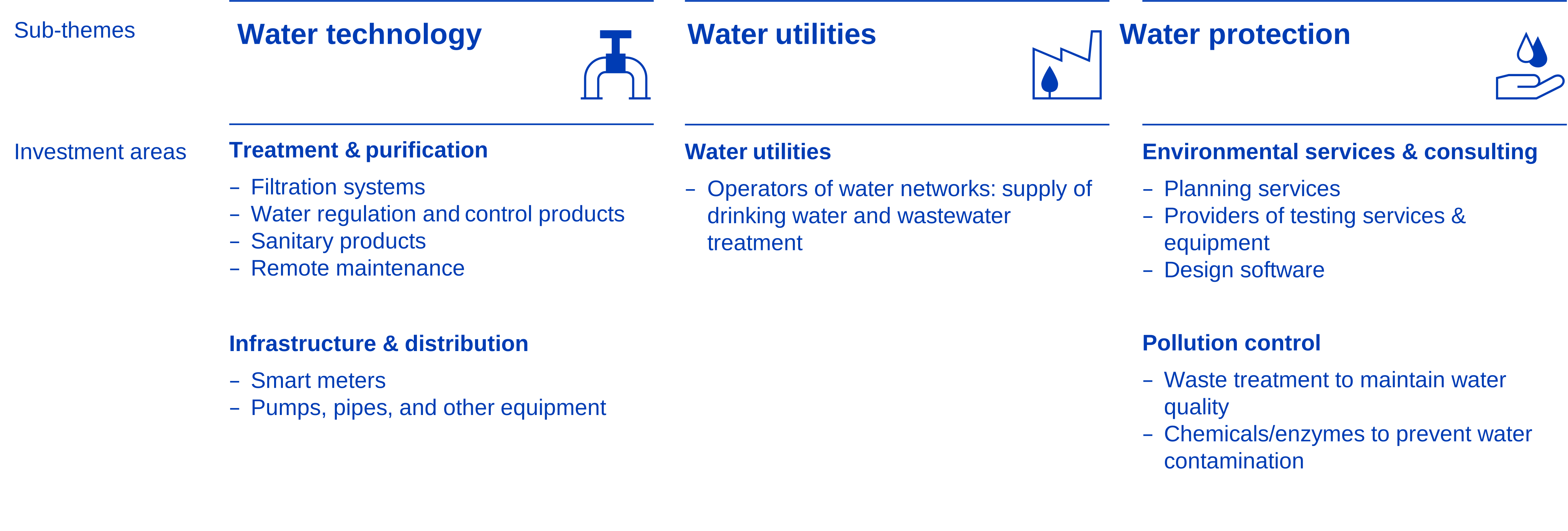
In our view, the aforementioned focus on nature-based and technical solutions also appears promising on a global scale. In particular, innovative companies in water technology, water protection and water utilities can offer attractive opportunities (see chart below).
Water sector with attractive investment opportunities
This is supported, on the one hand, by the above-average growth potential; the water sector is growing at an average rate of 4 to 6%, roughly twice as fast as global GDP. We focus on companies whose products and services address the UN's Sustainable Development Goals (SDGs). On the other hand, we prioritise quality, investing only in companies that can earn their cost of capital over the long term, have stable balance sheets, and boast a convincing management team.
Growth drivers: Water Scarcity, water infrastructure, and water quality
Looking at the above-average growth of the water sector, we identify the following drivers: In addition to the high demand for water, these include urgent investments in aging water infrastructure in many places. In the UK, for example, the analysis service DiscoverWater reports that around 3 million litres of drinking water are lost daily during transport. In the US, the American Society of Civil Engineers estimates the investment need in water infrastructure will reach USD 1 trillion by 2033. Finally, increasing demands for water quality, particularly in connection with the boom in artificial intelligence, are another driver.
These drivers impact a wide range of applications, which we consider particularly attractive in the three investment areas of water technology, water protection, and water utilities:
- Water technology: Advanced metering infrastructure, smart software applications, water treatment
- Water protection: Prevention of resource depletion, complex management of industrial wastewater, recycling and reuse to support freshwater reserves
- Water utilities: Seawater desalination, modernisation of water infrastructure, digital systems for optimised freshwater distribution, and leak detection in pipelines
To identify potential return growth, sustainability, and quality in these areas while diversifying risks, it may be worthwhile to rely on actively managed investment funds by experts. Learn more here about Swisscanto's sustainable water and water protection strategy – and other structural investment themes:
Investmentthema «Water» im Gespräch
Legal disclaimer Switzerland
Legal disclaimer Switzerland
This document only serves advertising and information purposes, is for distribution in Switzerland only and is not directed at persons in whose nationality or place of residence prohibit access to such information under applicable law. Where not indicated otherwise, the information concerns the collective investment schemes under the law of Luxembourg managed by Swisscanto Asset Management International S.A. (hereinafter "Swisscanto Funds"). The products described are undertakings for collective investment in transferable securities (UCITS) within the meaning of EU Directive 2009/65/EC, which is governed by Luxembourg law and subject to the supervision of the Luxembourg supervisory authority (CSSF). This document does not constitute a solicitation or invitation to subscribe or make an offer to purchase any securities, nor does it form the basis of any contract or obligation of any kind. The sole binding basis for the acquisition of Swisscanto Funds are the respective legal documents (management regulations, sales prospectuses and key information documents (PRIIP KID), as well as financial reports), which can be obtained free of charge at https://products.swisscanto.com as well as at Swisscanto Fondsleitung AG, Bahnhofstrasse 9, CH-8001 Zurich (also acting as representative of the Luxembourg Swisscanto funds in Switzerland) or in all offices of Zürcher Kantonalbank. Paying Agent for the Luxembourg Swisscanto funds in Switzerland is Zürcher Kantonalbank, Bahnhofstrasse 9, CH-8001 Zurich. Information about the sustainability-relevant aspects in accordance with the Regulation (EU) 2019/2088 as well as Swisscanto's strategy for the promotion of sustainability and the pursuit of sustainability goals in the fund investment process are available on the same website. The sub-fund referred to in the document is subject to Article 9 of Regulation (EU) 2019/2088. The distribution of the fund may be suspended at any time. Investors will be informed about the deregistration in due time. The investment involves risks, in particular those of fluctuations in value and earnings. Investments in foreign currencies are subject to exchange rate fluctuations. Past performance is neither an indicator nor a guarantee of future success. The risks are described in the sales prospectus and in the PRIIP KID. The information contained in this document has been compiled with the greatest care. Despite professional procedures, the correctness, completeness and topicality of the information cannot be guaranteed. Any liability for investments based on this document will be rejected. The document does not release the recipient from his or her own judgment. In particular, the recipient is recommended to check the information for compatibility with his or her personal circumstances as well as for legal, tax and other consequences, if necessary, with the help of an advisor. The prospectus and PRIIP KID should be read before making any final investment decision. The products and services described in this document are not available to U.S. persons under the relevant regulations (in particular Regulation S under the U.S. Securities Act of 1933).
Data as at (where not stated otherwise): 11.2024
© Zürcher Kantonalbank. All rights reserved.
Legal disclaimer international
Legal disclaimer international
This document only serves advertising and information purposes and is not directed at persons in whose nationality or place of residence prohibit access to such information under applicable law. Where not indicated otherwise, the information concerns the collective investment schemes under the law of Luxembourg managed by Swisscanto Asset Management International S.A. (hereinafter "Swisscanto Funds"). The products described are undertakings for collective investment in transferable securities (UCITS) within the meaning of EU Directive 2009/65/EC, which is governed by Luxembourg law and subject to the supervision of the Luxembourg supervisory authority (CSSF).
This document does not constitute a solicitation or invitation to subscribe or make an offer to purchase any securities, nor does it form the basis of any contract or obligation of any kind. The sole binding basis for the acquisition of Swisscanto Funds are the respective published legal documents (management regulations, sales prospectuses and key information documents (PRIIP KID), as well as financial reports), which can be obtained free of charge at https://products.swisscanto.com/. Information about the sustainability-relevant aspects in accordance with the Regulation (EU) 2019/2088 as well as Swisscanto's strategy for the promotion of sustainability and the pursuit of sustainability goals in the fund investment process are available on the same website. The sub-fund referred to in the document is subject to Article 9 of Regulation (EU) 2019/2088.
The distribution of the fund may be suspended at any time. Investors will be informed about the deregistration in due time. The investment involves risks, in particular those of fluctuations in value and earnings. Investments in foreign currencies are subject to exchange rate fluctuations. Past performance is neither an indicator nor a guarantee of future success. The risks are described in the sales prospectus and in the PRIIP KID. The information contained in this document has been compiled with the greatest care. Despite professional procedures, the correctness, completeness and topicality of the information cannot be guaranteed. Any liability for investments based on this document will be rejected. The document does not release the recipient from his or her own judgment. In particular, the recipient is recommended to check the information for compatibility with his or her personal circumstances as well as for legal, tax and other consequences, if necessary, with the help of an advisor. The prospectus and PRIIP KID should be read before making any final investment decision.
An overview of investors' rights is available at https://www.swisscanto.com/int/en/legal/summary-of-investor-rights.html.
The products and services described in this document are not available to U.S. persons under the relevant regulations (in particular Regulation S under the U.S. Securities Act of 1933). Data as at (where not stated otherwise): 11.2024
© Zürcher Kantonalbank. All rights reserved.