Stock Market Year 2026: Bullseye on Two Out of Three Main Theses
The first six months of the stock market year were dominated by geopolitical crises and a strong AI boom. It's time for a mid-year review: How have our three main theses, formulated at the end of 2025, held up, and where do we need to adjust our strategy now?
Dr. Roger Rüegg
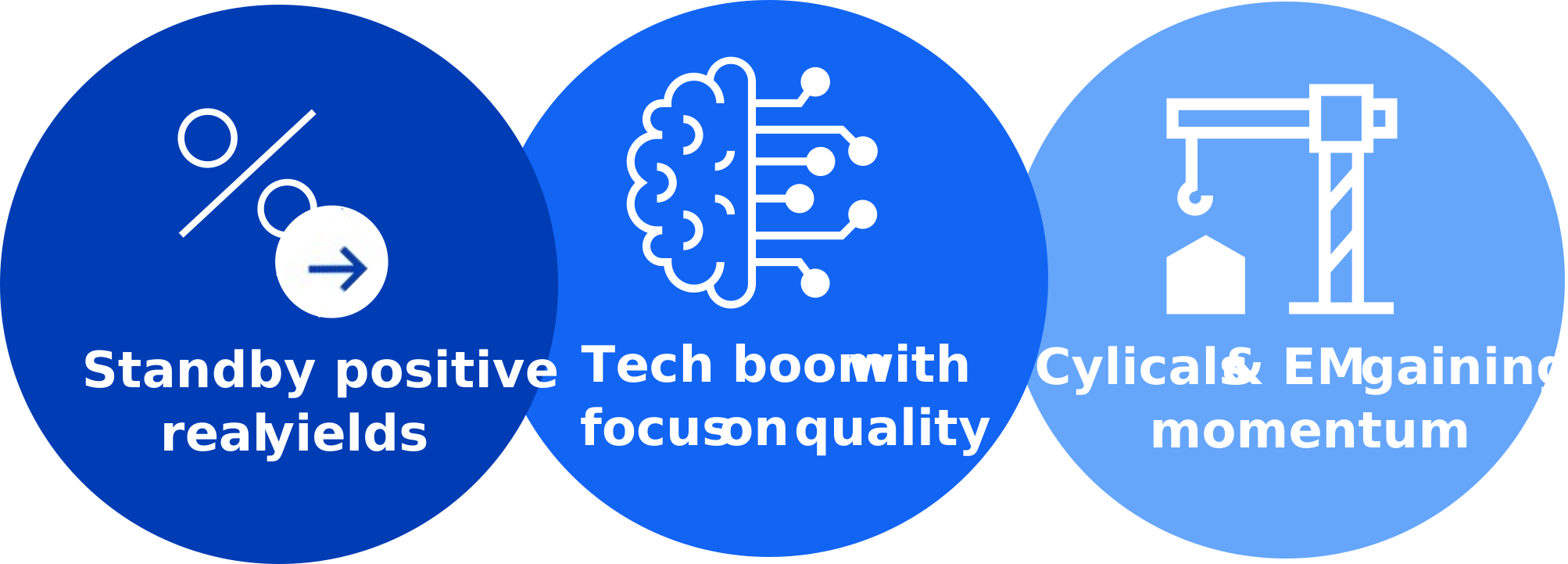
As we do every year, we presented three main theses for the upcoming year in our December 2025 Market Outlook:

Looking back at the first half of the year, it’s clear: two of the three theses were a bullseye. The technology sector once again proved to be the best-performing sector by far, delivering a return of more than 20%. Interestingly, unlike in previous years, it wasn’t the so-called "Magnificent 7" leading the charge, but rather the "second tier" companies like Intel and Micron driving performance. We believe the dominance of tech firms will persist in the second half of the year.
We also remain committed to the theme of electrification. The structural trend toward electric drives, smart grids, and an increasing number of electricity-intensive applications (data centres, e-mobility, heat pumps) continues to drive high investment demand across the entire value chain. These long-term growth drivers remain intact, regardless of short-term economic fluctuations.
Thanks to the strong performance of semiconductor stocks, namely SK Hynix, Samsung, and Taiwan Semiconductors, the MSCI Emerging Markets Index achieved a performance of around 24%, outperforming all other equity regions. Emerging market bonds also stood out, delivering a 4.5% return in CHF, making them top performers in the bond space. This positioning paid off handsomely.
Only the Naive Real Yield Declined
Although the naive real yield (yield to maturity minus current inflation rate) collapsed from around 2% to 0% due to the oil price shock triggered by the Iran war, the more accurate real yield, which accounts for inflation expectations, actually rose further (see Chart). This thesis, therefore, did not materialise, and government bonds (hedged in CHF) once again failed to make a significant contribution to performance. Similarly, the increased strategic allocation to gold and the reduction in USD exposure did not pass the reality test.
Adjustment no 1: "Standby" Instead of "Bye Bye" for Real Yields
One key reason why the thesis "Bye Bye Positive Real Yields" has not yet been confirmed is Kevin Warsh. The new Chair of the US Federal Reserve (Fed) has surprisingly emphasised his commitment to fighting inflation. This has restored market confidence, and concerns about the Fed’s independence have somewhat dissipated. Contrary to our original expectations, the Fed’s rate-cutting cycle now appears to be over. For the second half of the year, the outlook for real yields is more "Standby" than "Bye Bye." Consequently, the USD is likely to weaken less than initially feared, which in turn suggests a lower need for currency hedging.
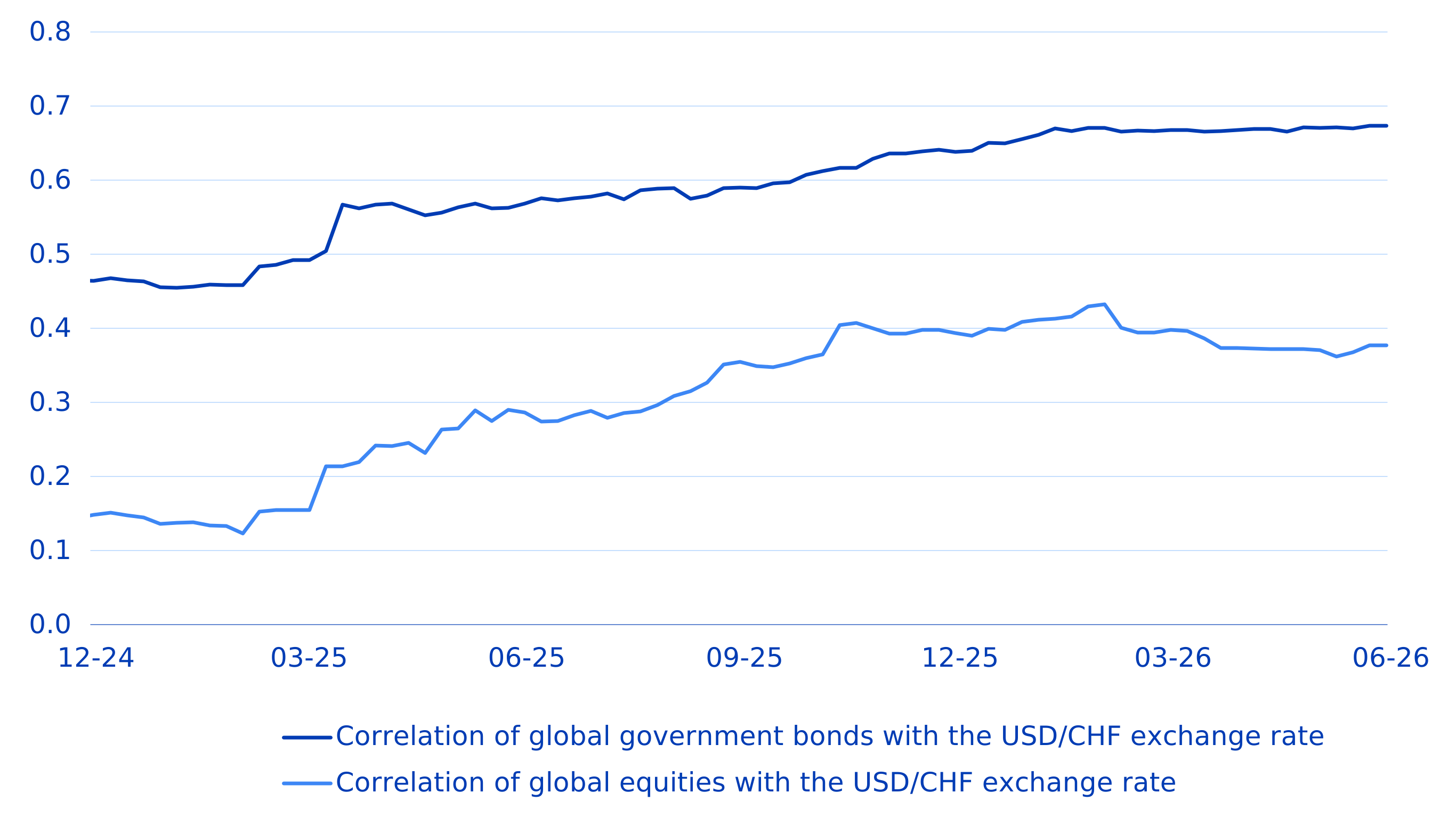
In addition to the currency outlook, the interest rate differential and risk diversification are also relevant for determining the optimal hedging ratio. The interest rate differential has risen from 2.8% at the beginning of the year to 3.2% today, which generally argues for a lower hedging ratio. However, caution is warranted from a risk perspective: the correlation between the USD/CHF exchange rate and foreign currency asset classes (dominated by the USD) has recently increased. For this reason, we are slightly increasing the USD allocation in the portfolio for the second half of the year—but not as much as the more positive currency outlook and interest rate differential would suggest.
Chart: Correlation Between Equities/Bonds and the USD/CHF Exchange Rate Rises, Increasing Portfolio Risk from USD Investments
Adjustment no 2: Cyclicals in the Fast Lane
Although we continue to view emerging markets as attractive, our confidence has slightly diminished. In our view, market breadth within emerging markets is poor, and we observe dangerous euphoria, particularly in Korea. Despite still low valuations and high earnings growth, the risk of a correction has increased. Additionally, the USD has shifted from being a driver to a drag for emerging markets. Our preference has therefore shifted more toward cyclical stocks, such as small caps and industrial companies in the circular economy, that are gaining momentum thanks to the strong US economy and generally exhibit solid earnings growth.
Adjusted Main Beliefs for the Second Half of 2026
Legal Notice
Legal Notice
“BLOOMBERG®” and the Bloomberg indices listed herein (the “Indices”) are service marks of Bloomberg Finance L.P. and its affiliates, including Bloomberg Index Services Limited (“BISL”), the administrator of the Indices (collectively, “Bloomberg”) and have been licensed for use for certain purposes by the distributor hereof (the “Licensee”). Bloomberg is not affiliated with Licensee, and Bloomberg does not approve, endorse, review, or recommend the financial products named herein (the “Products”). Bloomberg does not guarantee the timeliness, accuracy, or completeness of any data or information relating to the Products.
This document only serves advertising and information purposes and is not directed at persons in whose nationality or place of residence prohibit access to such information under applicable law. Where not indicated otherwise, the information concerns the collective investment schemes under the law of Luxembourg managed by Swisscanto Asset Management International S.A. (hereinafter "Swisscanto Funds"). The products described are undertakings for collective investment in transferable securities (UCITS) within the meaning of EU Directive 2009/65/EC, which are governed by Luxembourg law and subject to the supervision of the Luxembourg supervisory authority (CSSF).
This document does not constitute a solicitation or invitation to subscribe or make an offer to purchase any securities, nor does it form the basis of any contract or obligation of any kind. The sole binding basis for the acquisition of Swisscanto Funds are the respective published legal documents (management regulations, sales prospectuses and key information documents (PRIIP KID), as well as financial reports), which can be obtained free of charge at products.swisscanto.com. Information about the sustainability-relevant aspects in accordance with the Regulation (EU) 2019/2088 as well as Swisscanto's strategy for the promotion of sustainability and the pursuit of sustainability goals in the fund investment process are available on the same website.
The distribution of the fund may be suspended at any time. Investors will be informed about the deregistration in due time.
The investment involves risks, in particular those of fluctuations in value and earnings. Investments in foreign currencies are subject to exchange rate fluctuations. Past performance is neither an indicator nor a guarantee of future success. The risks are described in the sales prospectus and in the PRIIP KID.
The information contained in this document has been compiled with the greatest care. Despite professional procedures, the correctness, completeness and topicality of the information cannot be guaranteed. Any liability for investments based on this document will be rejected.
The opinions and assessments contained in this document regarding securities and/or issuers have not been prepared in accordance with the regulations governing the independence of financial analysts and therefore constitute marketing communications (and not independent financial analyses). In particular, the employees responsible for such opinions and assessments are not necessarily subject to restrictions on trading the relevant securities and may, in principle, conduct their own transactions in these securities.
The document does not release the recipient from his or her own judgment. In particular, the recipient is recommended to check the information for compatibility with his or her personal circumstances as well as for legal, tax and other consequences, if necessary, with the help of an advisor. The prospectus and PRIIP KID should be read before making any final investment decision.
An overview of investors' rights is available at swisscanto.com/int/en/legal/summary-of-investor-rights.html.
The products described in this document are not available to U.S. persons under the relevant regulations (in particular Regulation S under the U.S. Securities Act of 1933). Data as at (where not stated otherwise): 03.2026
© Swisscanto Asset Management International S.A. All rights reserved.