Taking profits on convertible bonds
Since our entry a year ago, convertible bonds outperformed global corporate bonds by 6%. We are now taking profits, as they lag small caps due to high exposure to unprofitable tech and crypto firms.
The recent escalation in Iran is causing uncertainty in the financial markets. Nevertheless, in our view, the impact on the global economy and markets is likely to remain limited. We are therefore maintaining, for the time being, the adjustments to our asset allocation decided for March.
Author: Nicola Grass
Although the escalation in Iran has the potential to shift the balance of power in the region, we consider the risks for global financial markets to be limited. In the medium term, a relaxation is even possible. The attack did not come entirely unexpectedly. The main threat concerns the production and delivery of crude oil and natural gas exported to the Far East (e.g. to Korea and India). However, we expect that any potential supply shortages can at least partially be covered by other producers. In this respect, we assume that the historical pattern of geopolitical crises will repeat itself and that the rise in oil prices will be temporary (see chart below).
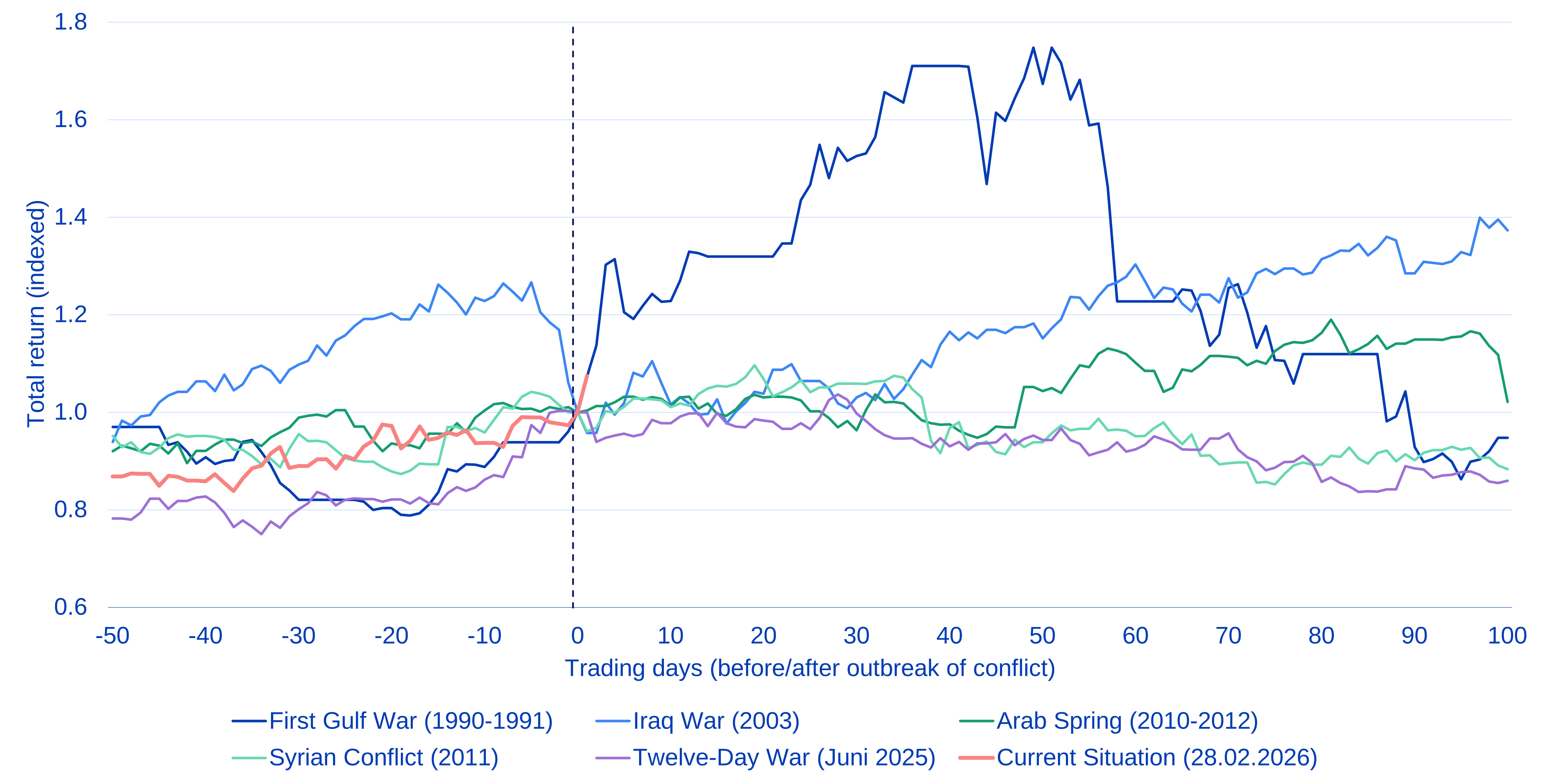
At the macroeconomic level, the world economy’s dependence on crude oil has generally decreased, and regional diversification has increased. In an initial reaction, typical safe havens such as gold, the Swiss franc, and the US dollar, as well as defensive consumer or pharmaceutical companies within equities, are likely to benefit. Overall, global financial markets are supported by falling interest rates and solid, growing corporate earnings, which makes the economy more resilient to a limited exogenous shock.
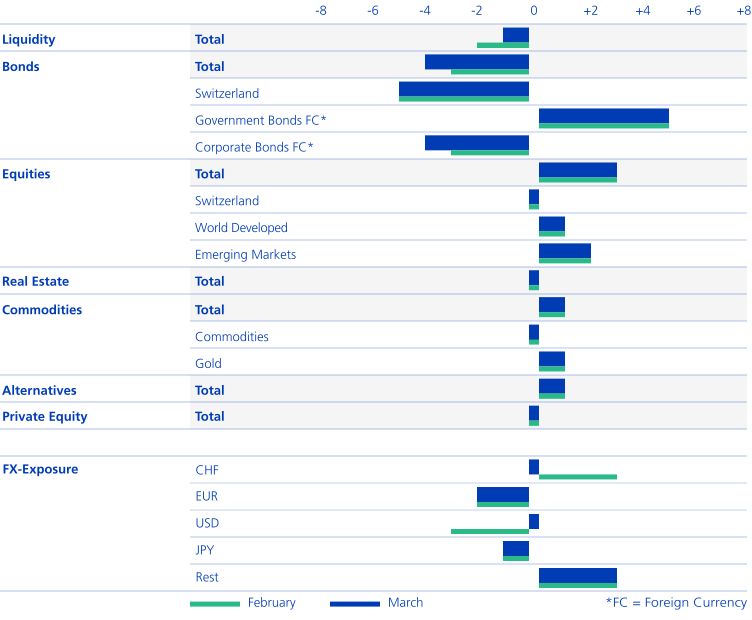
On balance, we do not expect a significant effect, as we have established offsetting positions through purchases of commodities, US dollars, and basic materials equities, as well as existing overweight positions in gold and alternative investments. In the short term, our investment strategy, with a beta above 1, will suffer from the current risk-off sentiment. Small caps and emerging markets, in particular, are likely to react negatively, as both segments have performed strongly recently and are therefore more likely to be subject to profit-taking. In addition, they are sensitive to rising oil prices. Government bonds are currently showing little movement, so the impact on the bond side is expected to remain limited.
We are convinced that geopolitical risks are often overestimated and rarely have lasting effects on financial markets. The global economy is robust, and we do not expect a significant negative impact on corporate earnings. We therefore remain constructive and maintain an overweight position in equities. However, should the oil price rise above USD 100 contrary to our expectations, we would reassess the need to reduce risk.

Concerns about high levels of investment in artificial intelligence (AI) and the potential threat this technology poses to software companies are currently dominating the market narrative. According to the latest BofA Fund Manager Survey, market participants believe that companies are currently overinvesting in AI. The hyperscalers (Alphabet, Meta, Amazon, Microsoft, and Oracle) are expected to invest around 92% of their cash flow in 2026. This naturally increases the pressure to monetise these investments. We recognise the shifting sentiment and are therefore increasing our allocation to cyclical sectors such as small caps and basic materials, while reducing our exposure to the broad US equity market (see chart). However, we are maintaining our position in the US technology index Nasdaq, as tech stocks continue to deliver impressive earnings and, following their recent underperformance, are now trading at significantly more attractive valuations. A counter-move therefore seems possible.
Given positive economic data, strong corporate earnings, and positive momentum, we believe the environment for equities remains generally favourable. Furthermore, the put/call ratio and various investor surveys indicate that euphoria has dissipated and investors have become much more cautious, which we view as a positive sign. As inflation in the US is now trending towards 2%, further interest rate cuts are to be expected. We therefore remain overweight equities, particularly in emerging markets. In the short term, geopolitical risks in Iran may cause some volatility. Our portfolios remain overweight gold and government bonds as a hedge in such scenarios. However, we expect the medium-term impact on financial markets to be negligible.
In February, bond yields fell across the board. The yield on 10-year US Treasuries is now just above 4%, putting us towards the lower end of the trading range. However, as investors remain significantly underweight in bonds, we are making no changes to our government bond allocation. The sale of convertible bonds has, however, slightly reduced our overall bond quota. We continue to see opportunities in local emerging market bonds and Australian government bonds, particularly in the currency, which we consider very attractive given a yield of 4%. No changes are being made to alternative investments, and we remain overweight in gold.
“BLOOMBERG®” and the Bloomberg indices listed herein (the “Indices”) are service marks of Bloomberg Finance L.P. and its affiliates, including Bloomberg Index Services Limited (“BISL”), the administrator of the Indices (collectively, “Bloomberg”) and have been licensed for use for certain purposes by the distributor hereof (the “Licensee”). Bloomberg is not affiliated with Licensee, and Bloomberg does not approve, endorse, review, or recommend the financial products named herein (the “Products”). Bloomberg does not guarantee the timeliness, accuracy, or completeness of any data or information relating to the Products.
This document is for information and advertising purposes only. It is intended for distribution in Switzerland and is not intended for investors in other countries.
It does not constitute an offer or a recommendation to purchase, hold or sell financial instruments or to obtain products or services, nor does it form the basis for a contract or an obligation of any kind. The recipient is advised to review the information, possibly with the assistance of an advisor, to determine its compatibility with their personal circumstances as well as its legal, regulatory, tax, and other implications. The information contained in this publication may be adjusted at any time.
The document was prepared by Zürcher Kantonalbank with customary due diligence and may contain information from carefully selected third-party sources. However, Zürcher Kantonalbank provides no warranty as to the correctness and completeness of the information contained therein and accepts no liability for damages resulting from the use of the document or information contained therein.
Unless otherwise stated, the information refers to Zürcher Kantonalbank's asset management under the Swisscanto brand, which primarily includes collective capital investments under Swiss, Luxembourg and Irish law (hereinafter referred to as "Swisscanto funds").
The investment opinions and assessments of securities and/or issuers contained in this document have not been prepared in accordance with the rules on the independence of financial analysts and therefore constitute marketing communications (and not independent financial analysis). In particular, the employees responsible for such opinions and assessments are not necessarily subject to restrictions on trading in the relevant securities and may in principle conduct their own transactions or transactions for Zürcher Kantonalbank in these securities.
The sole binding basis for purchasing Swisscanto funds is the current fund documents (e.g. fund agreements/contractual conditions, prospectuses, key investor information or basic information sheets as well as annual reports), which can be obtained from products.swisscanto.com/, Swisscanto Fund Management Company Ltd., Bahnhofstrasse 9, CH-8001 Zurich (also representative of the Luxembourg Swisscanto funds) or from all branch offices of Zürcher Kantonalbank. The paying agent for the Luxembourg Swisscanto funds in Switzerland is Zürcher Kantonalbank, Bahnhofstrasse 9, CH-8001 Zurich.
Carne Global Fund Managers (Schweiz) AG is the representative for funds domiciled in Ireland. Zürcher Kantonalbank is the paying agent for the Irish Swisscanto funds in Switzerland and Luxembourg funds.
It should be noted that any information about historical performance does not indicate current or future performance, and any performance data provided may not consider the commissions and costs incurred when issuing and redeeming fund units. Any estimates regarding future returns and risks contained in the document are for informational purposes only. Zürcher Kantonalbank does not provide any guarantee for this.
Every investment involves risks, especially with regard to fluctuations in value and return.
In terms of any sustainability information, please note that there is no generally accepted framework or list of factors in Switzerland that has to be considered in order to ensure the sustainability of investments.
For Irish and Luxembourgish Swisscanto funds, information on sustainability-related aspects in accordance with the Disclosure Regulation (EU) 2019/2088 is available at products.swisscanto.com/.
The products and services described in this publication are not available to US persons in accordance with the applicable regulations. This publication and the information contained in it must not be distributed and/or redistributed to, used or relied upon by, any person (whether individual or entity) who may be a US person under Regulation S of the US Securities Act of 1933. US persons include any US resident; any corporation, company, partnership or other entity organized under any law of the United States; and other categories set out in Regulation S. Status of the data (unless otherwise stated): 03.2025
© 2026 Zürcher Kantonalbank. All rights reserved.