Skip to Main Content

Asset Allocation Update: Corporate profits back in focus

For global equity markets, the war in Iran is over, and driven by the US stock market we are already back at an all-time high. The focus has shifted away from the Strait of Hormuz towards corporate earnings, which are above all driven by AI (+23% for US companies in Q1 year-on-year). Furthermore, we expect a looser monetary policy than the consensus. That is why our asset allocation remains overweight in equities, although this is somewhat less pronounced after this very strong rebound and given the vulnerabilities in the Middle East.

Nicola Grass

The semiconductor sector once again at the centre of market activity (Image: iStock.com).

What changes have we made to the portfolios?

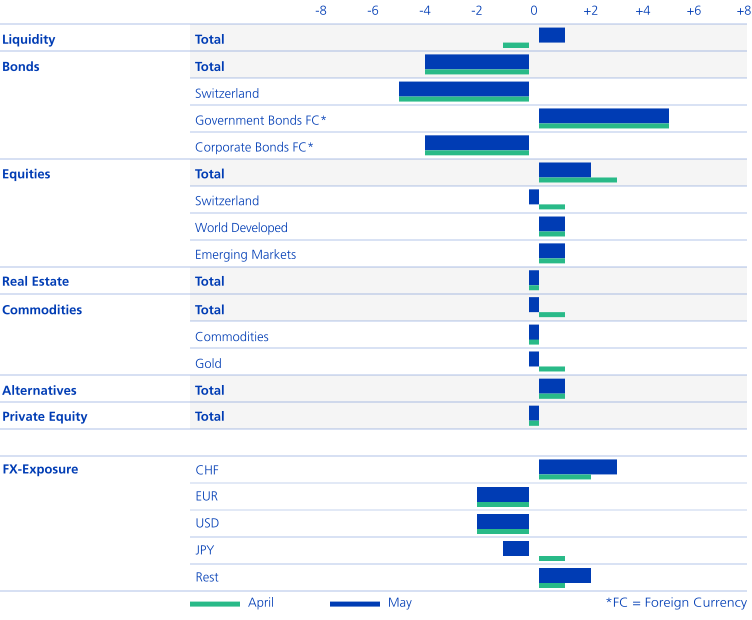
Switzerland lost more during the correction and did not gain more than global equities during the rebound. The main reason is likely the relatively weak earnings growth. Due to the lack of momentum, we are reducing to neutral.

As an alternative to Swiss equities, the UK is a defensive market with significantly better earnings growth and momentum. In addition, energy stocks have become attractive again after the recent correction. Valuations also speak in favour of the UK.

Euphoria in the gold market has eased somewhat and the gold price has lost momentum. Against this backdrop, a return to previous highs seems unlikely. We are reducing to neutral.

The yen is inexpensive, but remains cheap, particularly against the Swiss franc. The Bank of Japan once again refrained from raising interest rates in April, disappointing us again. After the recent build-up, we are already selling it again.

From Hormuz to semiconductors

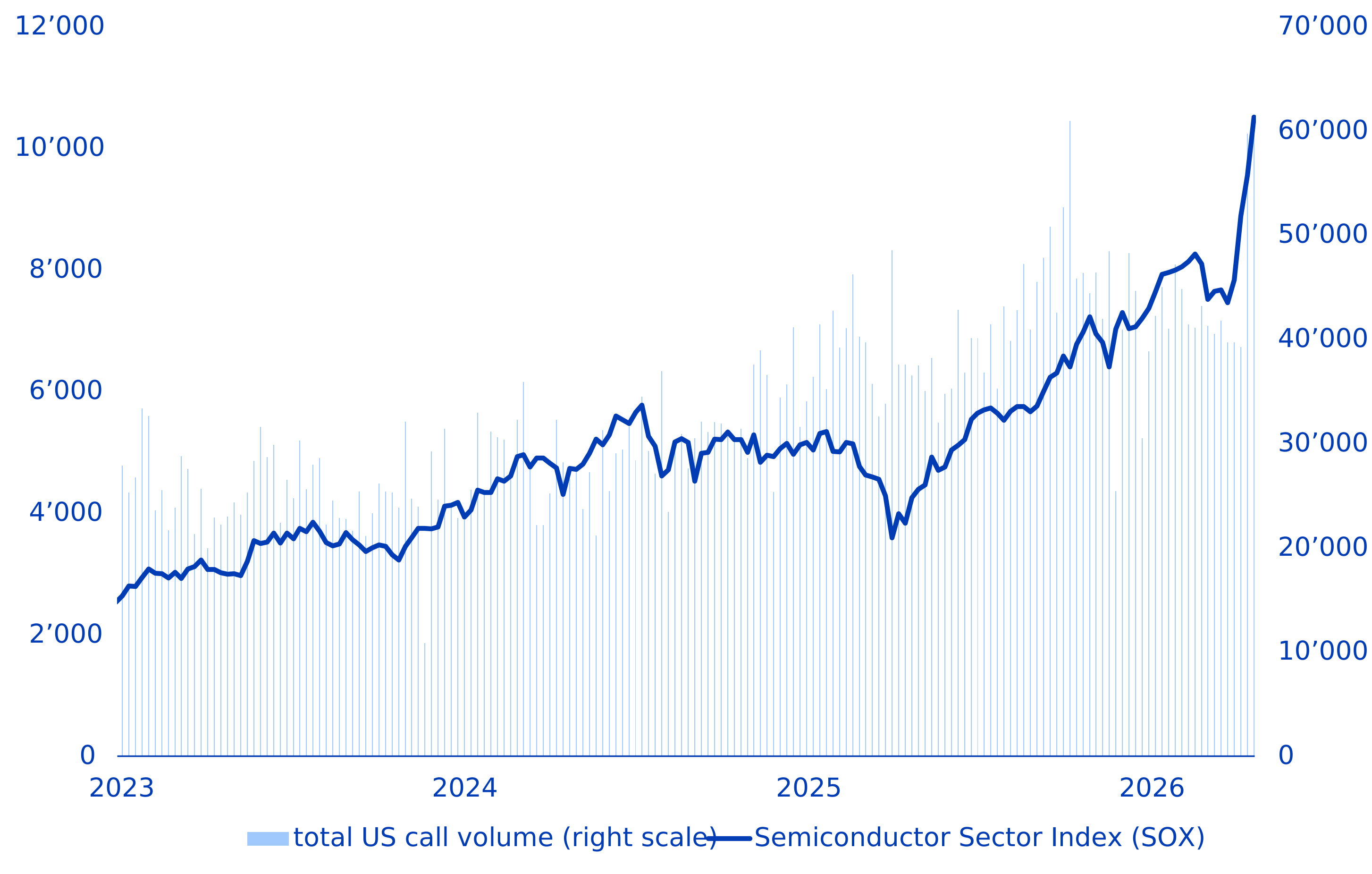
Political stock markets have short legs – and this market adage has once again been impressively confirmed. After equity markets corrected by around 10% in March, we were already back at a new all‑time high less than a month later. The willingness of the three parties involved to de‑escalate appears to have been sufficient for equity investors, even though the Strait of Hormuz remains practically closed and the oil price is still trading above USD 100 after two months. The focus has already shifted back to other topics, such as artificial intelligence and the massive investment in data centres. Semiconductor stocks, for instance, gained almost 50% in April (see chart). A certain degree of euphoria seems to be building again here, and the sector is now heavily overbought. Overall, risk appetite has risen sharply and call volumes are significantly higher than put volumes. We are therefore trimming momentum in equities somewhat again for May, and with it our exposure to the red‑hot theme of electrification.

Chart: Investors turning euphoric again


Source: Bloomberg, Zürcher Kantonalbank

From inflation shock to slowing growth

In the first phase of the Iran war, the surge in oil prices triggered fears of inflation. As a result, interest rate hikes were priced in for almost all central banks. This panic has now eased somewhat and inflation expectations have fallen. For the Fed, a rate cut towards the end of the year is once again being priced in. This is what we had anticipated and why we increased duration at the end of March. Now, however, concerns about growth are beginning to emerge, and our economists have once again revised down their GDP forecast for the US. Leading indicators have so far remained surprisingly robust, and a recession still appears unlikely. For equity markets, this would not necessarily be negative, as weaker growth makes further rate cuts more likely. In combination with strong corporate earnings, this continues to argue in favour of equities.

From gold and yen to the Swiss franc

Outside equities, however, we are acting rather cautiously. In bonds, for example, we remain heavily underweight in credit and are instead overweight in global government bonds with longer duration. We see significantly greater potential for price gains from falling yields outside Switzerland. We hold real estate and commodities at neutral weight and continue to favour catastrophe bonds. We are now also neutrally weighted in gold. In currencies, we are no longer overweight in JPY and AUD, but only in the Swiss franc. Thanks to its low level of government debt and comparatively low inflation, the franc remains in demand and is, in our view, the best safe haven.

Asset Allocation Update in May 2026

Relative weighting vs. Strategic Asset Allocation (SAA) in % in April and Mai 2026 (Source: Zürcher Kantonalbank, Asset Management)

Legal notice

“BLOOMBERG®” and the Bloomberg indices listed herein (the “Indices”) are service marks of Bloomberg Finance L.P. and its affiliates, including Bloomberg Index Services Limited (“BISL”), the administrator of the Indices (collectively, “Bloomberg”) and have been licensed for use for certain purposes by the distributor hereof (the “Licensee”). Bloomberg is not affiliated with Licensee, and Bloomberg does not approve, endorse, review, or recommend the financial products named herein (the “Products”). Bloomberg does not guarantee the timeliness, accuracy, or completeness of any data or information relating to the Products.

This document is for information and advertising purposes only. It is intended for distribution in Switzerland and is not intended for investors in other countries.

It does not constitute an offer or a recommendation to purchase, hold or sell financial instruments or to obtain products or services, nor does it form the basis for a contract or an obligation of any kind. The recipient is advised to review the information, possibly with the assistance of an advisor, to determine its compatibility with their personal circumstances as well as its legal, regulatory, tax, and other implications. The information contained in this publication may be adjusted at any time.

The document was prepared by Zürcher Kantonalbank with customary due diligence and may contain information from carefully selected third-party sources. However, Zürcher Kantonalbank provides no warranty as to the correctness and completeness of the information contained therein and accepts no liability for damages resulting from the use of the document or information contained therein.

Unless otherwise stated, the information refers to Zürcher Kantonalbank's asset management under the Swisscanto brand, which primarily includes collective capital investments under Swiss, Luxembourg and Irish law (hereinafter referred to as "Swisscanto funds").

The investment opinions and assessments of securities and/or issuers contained in this document have not been prepared in accordance with the rules on the independence of financial analysts and therefore constitute marketing communications (and not independent financial analysis). In particular, the employees responsible for such opinions and assessments are not necessarily subject to restrictions on trading in the relevant securities and may in principle conduct their own transactions or transactions for Zürcher Kantonalbank in these securities.

The sole binding basis for purchasing Swisscanto funds is the current fund documents (e.g. fund agreements/contractual conditions, prospectuses, key investor information or basic information sheets as well as annual reports), which can be obtained from products.swisscanto.com/, Swisscanto Fund Management Company Ltd., Bahnhofstrasse 9, CH-8001 Zurich (also representative of the Luxembourg Swisscanto funds) or from all branch offices of Zürcher Kantonalbank. The paying agent for the Luxembourg Swisscanto funds in Switzerland is Zürcher Kantonalbank, Bahnhofstrasse 9, CH-8001 Zurich.

It should be noted that any information about historical performance does not indicate current or future performance, and any performance data provided may not consider the commissions and costs incurred when issuing and redeeming fund units. Any estimates regarding future returns and risks contained in the document are for informational purposes only. Zürcher Kantonalbank does not provide any guarantee for this.

Every investment involves risks, especially with regard to fluctuations in value and return.

The products and services described in this publication are not available to US persons in accordance with the applicable regulations. This publication and the information contained in it must not be distributed and/or redistributed to, used or relied upon by, any person (whether individual or entity) who may be a US person under Regulation S of the US Securities Act of 1933. US persons include any US resident; any corporation, company, partnership or other entity organized under any law of the United States; and other categories set out in Regulation S. Status of the data (unless otherwise stated): 03.2026

© 2026 Zürcher Kantonalbank. All rights reserved.

Categories

Investment Strategy