Swiss bond market: Why corporates make the difference now
The interest rate reversal is behind us, uncertainty in the Middle East persists – and yet the Swiss bond market appears surprisingly calm. However, those who, like Sven Wagner, take a closer look will notice an imbalance: most portfolios are still heavily invested in very safe, long-term securities, while returns increasingly come from risk premiums. This is the moment for CHF corporate bonds to shine.
Author: Sven Wagner, Senior Portfolio Manager Swiss Fixed Income at the Asset Management of Zürcher Kantonalbank

Three key points about CHF corporate bonds
- The Swiss bond market is large, but it is dominated by securities with AAA and AA credit ratings. Many portfolios also carry more interest rate risk than necessary and are often not adequately compensated for it.
- CHF corporate bonds shift the focus towards the A and BBB segments. Here, investors can currently find credit premiums without resorting to low credit ratings or very long maturities.
- The corporate segment has grown significantly and become more international. This results in more issuers, higher liquidity, and a broader sector selection – without additional currency risks for CHF investors.
Switzerland is currently in a unique monetary policy position. Inflation remains low, the Swiss National Bank (SNB) can afford a wait-and-see approach and yields on Swiss government bonds – the Confederation bonds – are once again well below 1%. For many investors, it is clear: capital gains from falling interest rates will become the exception, while ongoing returns will become the rule.
Forgoing carry in a low-interest environment?
Today, these returns are primarily generated in the credit segment. Those who invest exclusively in government bonds and covered bonds forgo a significant portion of the available carry, i.e., the coupon yield. In our view, this results in a very solid but also correspondingly "expensive" risk profile.
The two charts (see below) illustrate the difference: in the overall index SBI Total, the interest rate component dominated during the negative interest rate phase – albeit with a negative sign – and temporarily led to clearly negative total returns. In the corporate index, the credit spread contributes a significantly larger share to the total return and helped keep performance in positive territory over longer periods.
SBI total index and SBI corporate: contribution of yield and spread to return (in %)
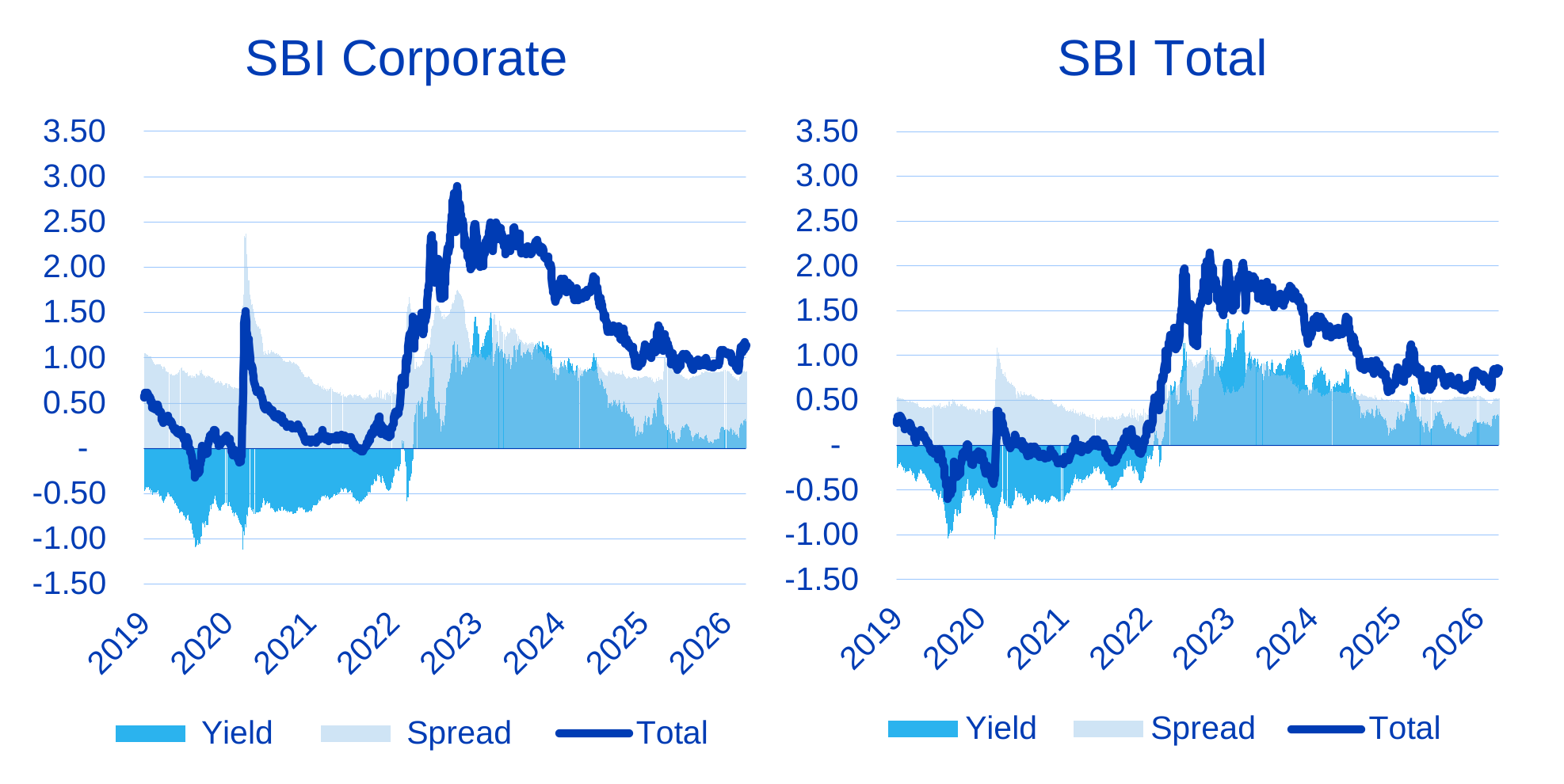
CHF corporate bonds thus offer a more natural balance. They combine the stability of the CHF market with noticeably higher risk premiums – predominantly from issuers with solid investment-grade ratings.
From the "overinsured" index to a more efficient allocation in CHF corporates
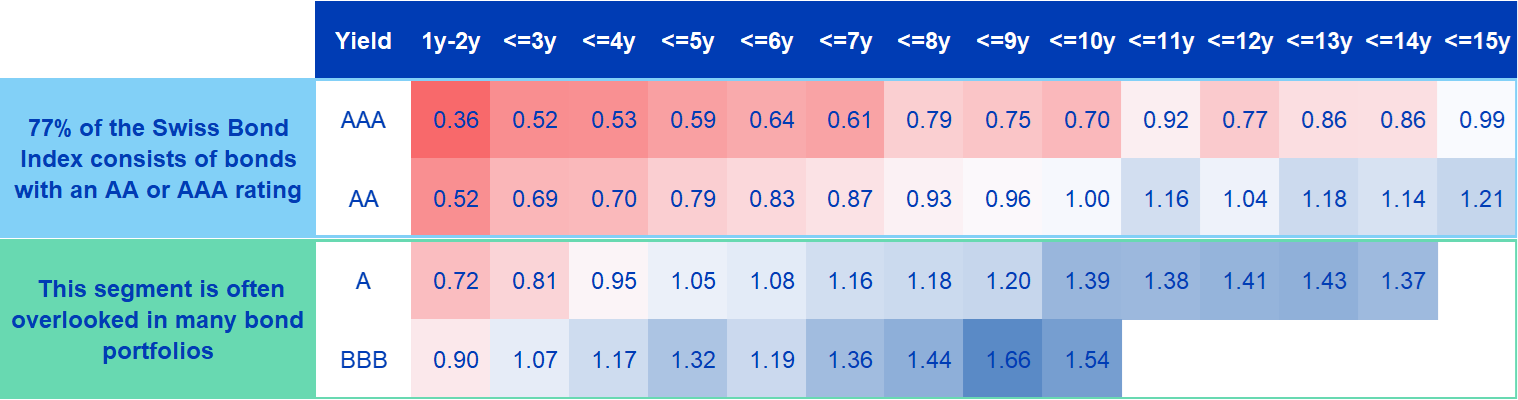
The Swiss Bond Index (SBI) AAA–BBB is the natural reference point for many institutional investors. However, it has a very high proportion of bonds with the top credit rating of AAA, while the major international aggregate indices in EUR or USD have only low single-digit percentage weights in AAA-rated securities. The two covered bond institutions and the Confederation alone account for a large part of the Swiss bond universe. At the same time, the interest rate sensitivity in the SBI AAA–BBB is high: duration is well over seven years, and for Confederation bonds, it is even in the double-digit range.
For this reason, an active approach with targeted management of maturities and issuers can be worthwhile in the overall market, as we have previously analyzed.
For many investors, the profile of the SBI AAA–BBB is likely to be too aggressive on the fixed-income side and too defensive on the credit side. A deliberate inclusion of corporate bonds, on the other hand, allows for:
- Bringing duration closer to actual needs
- Increasing the ongoing yield at comparable maturities
- Shifting portfolio risk more from the interest rate side to the credit side
In other words: those who include CHF corporate bonds reduce a segment that is heavily influenced by technical and regulatory factors and offers little additional compensation at very long maturities. The pure corporate bond index SBI Corporate has a significantly lower interest rate sensitivity with a duration of just over four and a half years. At the same time, yields can be higher, and ongoing interest income more attractive, while the average rating remains in the A range.
Yield profile of the Swiss Bond Index by maturity and rating
The CHF corporate bond market has matured
The CHF corporate bond market has experienced significant growth in recent years. A look at the outstanding nominal volume (see chart below) shows: over the past ten years, the corporate segment of the Swiss Bond Index has grown by about 45% to over CHF 160 billion today.
Growth of the CHF corporate bond segment (outstanding nominal amount in CHF billion)
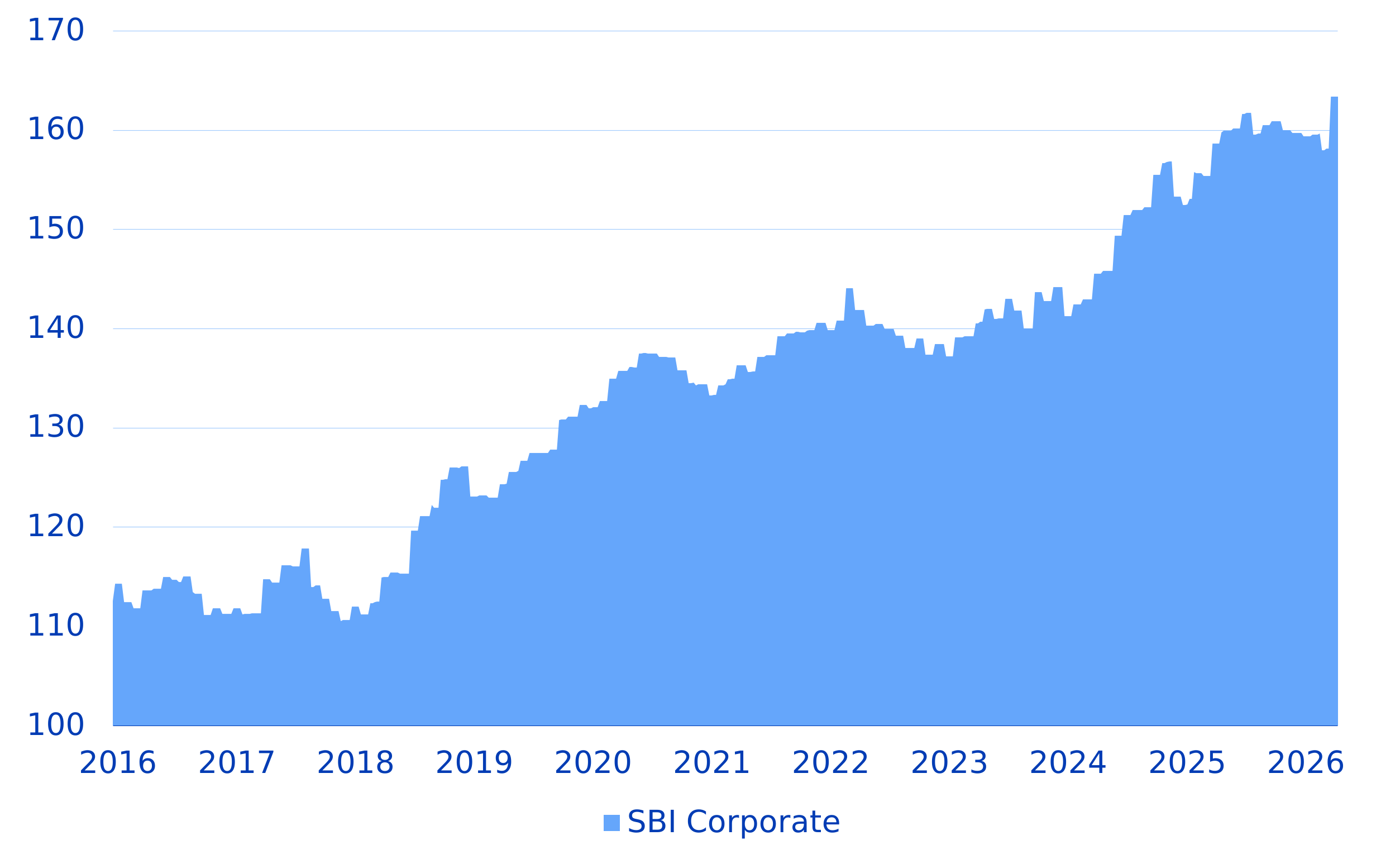
This growth is not just a matter of volume but also breadth. Ten years ago, the corporate universe in the SBI included 179 issuers with about 450 bonds; today, there are over 240 issuers with more than 800 outstanding bonds. In addition to established Swiss blue chips, banks, insurers, utilities, and real estate companies, international corporations are increasingly using the Swiss franc as a financing currency.
The top issuers in the index (see table below) – from Nestlé, Roche, Swisscom, and Novartis to major financial institutions like Crédit Agricole, Santander, or Helvetia Baloise, to industrial companies like SGS or Sika – illustrate how broad the spectrum is. For investors, this means access to a mix of globally leading companies and solidly anchored Swiss issuers, all in the domestic currency.
The transformation is particularly evident among large technology companies: "Hyperscalers" like Alphabet or Amazon are now financing parts of their AI and data center investments in the CHF market. Such issuances complement the traditional profile of the Swiss corporate segment with a growth-oriented, infrastructure-like component.
With this expansion, liquidity has also increased. Order books are broader, the number of active brokers is larger, and relative value opportunities can now be worked out much more precisely across maturities, issuers, and sectors. The market has thus evolved from a niche universe into an independent, well-traded segment that can play a central role in institutional CHF investments.
Spreads and quality of CHF corporates in the international comparison
Looking beyond Switzerland's borders reveals that the risk premiums (spreads) of corporate bonds in EUR and USD are currently near the lowest levels of the past 20 years. Investors in these international markets who hedge against currency risk will find that much of the yield advantage is eroded by this hedging. What remains are returns that often hardly differ from CHF corporate bonds – but with significantly higher interest rate and market risk.
CHF corporate bonds, on the other hand, can offer the following advantages:
- Spreads that, in their historical context, signal neither panic nor overconfidence
- Issuer quality that is on average clearly investment-grade
- No currency risks for investors in the CHF area
In an environment of geopolitical uncertainty and high sovereign debt in many countries, this combination of "Swiss quality" and attractive credit premiums can be particularly noteworthy.
Active risk: taking it a step further with CHF corporate bonds
The CHF corporate bond market also offers opportunities for investors willing to take an additional step. For example, those who have built a core portfolio with A and BBB rated issuers can unlock additional return drivers with targeted positions. This is precisely where the Swisscanto (CH) Bond Fund Responsible Corporate CHF comes in.
The fund relies on a fundamental analysis of all relevant CHF issuers. A specialized credit research team evaluates business models, balance sheet quality, cash flows, and capital structure – supplemented by sustainable aspects in the areas of environment, society, and good governance (ESG). These assessments are incorporated into a structured investment process that combines qualitative analyst opinions with quantitative models.
Based on this, the portfolio takes deliberate active positions with high conviction – whether across different issuers or along the capital structure of individual debtors.
Additionally, the strategy is adjusted using interest rate and credit derivatives, allowing duration and credit beta to be managed independently of individual securities holdings. This enables the overall portfolio to be flexibly adapted to the interest rate and credit environment without having to forgo carefully built positions.
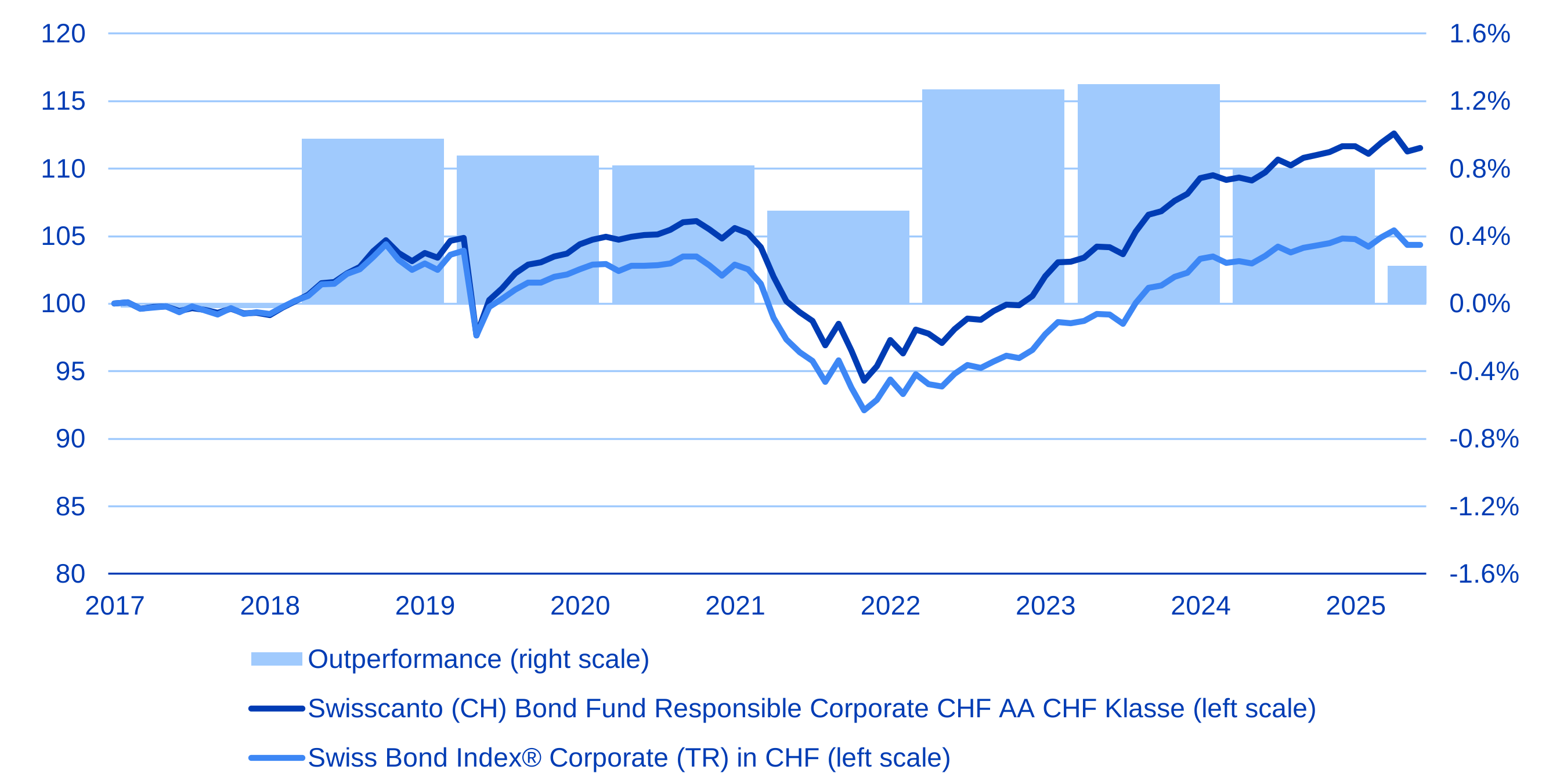
The history demonstrates the effectiveness of this approach: over several years, the fund has consistently outperformed its corporate benchmark, generating significant excess returns – all while maintaining controlled risk (see chart below). It should be noted that past performance is not indicative of future returns.
Gross performance of the Swisscanto (CH) Bond Fund Responsible Corporate CHF (since 1.12.2017, in %)
What does this mean for investors?
Not all investors start from the same position. Family offices or (affluent) private clients often have the freedom to choose bond strategies based on yield, risk, and liquidity considerations. Pension funds and insurers, on the other hand, operate more within the framework of BVV2 guidelines, ALM considerations, and solvency requirements.
Despite these differences, the practice shows: a moderate build-up of CHF corporate bonds can be well integrated into most strategies without violating regulatory or balance sheet constraints. The corporate exposure can be calibrated to increase ongoing yield and better balance duration – while respecting quality requirements and regulatory guidelines.
- CHF corporate bonds are, in our view, the natural place to generate carry in the Swiss bond market today. With the return of low government bond yields, most of the additional return now comes from credit spreads – and these are found in the corporate segment.
- The market is larger, more liquid, and more international than ever. From smaller domestic industrial companies, hospitals, or utilities to international blue chips, the universe offers a broadly diversified, predominantly high-quality set of issuers – without currency risk for investors in Switzerland.
- In our view, for most investors there is no getting around the need for a deliberate allocation to CHF corporate bonds. Those who invest exclusively in the SBI Index as a whole are exposed to more interest rate risk – and lower returns – than is necessary. A carefully constructed CHF corporate bond component makes it possible to increase expected returns without fundamentally altering the portfolio’s risk profile.
Top 20 issuers from the CHF corporate sector
| Issuer | Share (%) |
|---|---|
| Nestle Capital Corp. | 3.6% |
| Roche Holdings, Inc. | 2.6% |
| Swisscom AG | 2.4% |
| Credit Agricole S.A. | 1.9% |
| Novartis Capital Corp. | 1.9% |
| Alphabet Inc. | 1.8% |
| Deutsche Bahn Finance GmbH | 1.8% |
| Banco Santander S.A. | 1.7% |
| Helvetia Baloise Holding Ltd. | 1.4% |
| SGS SA | 1.4% |
| Sika AG | 1.3% |
| BNP Paribas Issuance B.V. | 1.3% |
| LGT Bank AG | 1.3% |
| Thermo Fisher Scientific Inc. | 1.3% |
| Raiffeisen Schweiz Genossenschaft | 1.1% |
| Georg Fischer Finanz AG | 1.1% |
| Swiss Prime Site AG | 1.1% |
| Banque Cantonale Vaudoise | 1.0% |
| Toyota Motor Finance | 1.0% |
| UBS AG | 1.0% |
Quelle: ZKB, Bloomberg, per 11.5.2026
Fund in the spotlight
Fund in the spotlight
Legal notices
Legal notices
Legal information regarding the charts
“BLOOMBERG®” and the Bloomberg indices listed herein (the “Indices”) are service marks of Bloomberg Finance L.P. and its affiliates, including Bloomberg Index Services Limited (“BISL”), the administrator of the Indices (collectively, “Bloomberg”) and have been licensed for use for certain purposes by the distributor hereof (the “Licensee”). Bloomberg is not affiliated with Licensee, and Bloomberg does not approve, endorse, review, or recommend the financial products named herein (the “Products”). Bloomberg does not guarantee the timeliness, accuracy, or completeness of any data or information relating to the Products.
SIX Index AG ist die Quelle des jeweiligen Index und der darin enthaltenen Daten. SIX Index AG war in keinerlei Form an der Erstellung der in dieser Berichterstattung enthaltenen Informationen beteiligt. SIX Index AG übernimmt keinerlei Gewährleistung und schliesst jegliche Haftung (sowohl aus fahrlässigem sowie aus anderem Verhalten) in Bezug auf die Genauigkeit, Angemessenheit, Richtigkeit, Vollständigkeit, Rechtzeitigkeit und Eignung für beliebigen Zwecke so wie hinsichtlich Fehler, Auslassungen oder Unterbrechungen im entsprechenden Index oder dessen Daten aus. Jegliche Verbreitung oder Weitergabe, der von SIX Index AG stammenden Informationen ist untersagt.
Legal notice
This document is for information and advertising purposes only. It is intended for distribution in Switzerland and is not intended for investors in other countries.
It does not constitute an offer or a recommendation to purchase, hold or sell financial instruments or to obtain products or services, nor does it form the basis for a contract or an obligation of any kind. The recipient is advised to review the information, possibly with the assistance of an advisor, to determine its compatibility with their personal circumstances as well as its legal, regulatory, tax, and other implications. The information contained in this publication may be adjusted at any time.
The document was prepared by Zürcher Kantonalbank with customary due diligence and may contain information from carefully selected third-party sources. However, Zürcher Kantonalbank provides no warranty as to the correctness and completeness of the information contained therein and accepts no liability for damages resulting from the use of the document or information contained therein.
Unless otherwise stated, the information refers to Zürcher Kantonalbank's asset management under the Swisscanto brand, which primarily includes collective capital investments under Swiss, Luxembourg and Irish law (hereinafter referred to as "Swisscanto funds").
The investment opinions and assessments of securities and/or issuers contained in this document have not been prepared in accordance with the rules on the independence of financial analysts and therefore constitute marketing communications (and not independent financial analysis). In particular, the employees responsible for such opinions and assessments are not necessarily subject to restrictions on trading in the relevant securities and may in principle conduct their own transactions or transactions for Zürcher Kantonalbank in these securities.
The sole binding basis for purchasing Swisscanto funds is the current fund documents (e.g. fund agreements/contractual conditions, prospectuses, key investor information or basic information sheets as well as annual reports), which can be obtained from products.swisscanto.com/, Swisscanto Fund Management Company Ltd., Bahnhofstrasse 9, CH-8001 Zurich (also representative of the Luxembourg Swisscanto funds) or from all branch offices of Zürcher Kantonalbank. The paying agent for the Luxembourg Swisscanto funds in Switzerland is Zürcher Kantonalbank, Bahnhofstrasse 9, CH-8001 Zurich.
Carne Global Fund Managers (Schweiz) AG is the representative for funds domiciled in Ireland. Zürcher Kantonalbank is the paying agent for the Irish Swisscanto funds in Switzerland and Luxembourg funds.
It should be noted that any information about historical performance does not indicate current or future performance, and any performance data provided may not consider the commissions and costs incurred when issuing and redeeming fund units. Any estimates regarding future returns and risks contained in the document are for informational purposes only. Zürcher Kantonalbank does not provide any guarantee for this.
Every investment involves risks, especially with regard to fluctuations in value and return.
In terms of any sustainability information, please note that there is no generally accepted framework or list of factors in Switzerland that has to be considered in order to ensure the sustainability of investments.
For Irish and Luxembourgish Swisscanto funds, information on sustainability-related aspects in accordance with the Disclosure Regulation (EU) 2019/2088 is available at products.swisscanto.com/.
The products and services described in this publication are not available to US persons in accordance with the applicable regulations. This publication and the information contained in it must not be distributed and/or redistributed to, used or relied upon by, any person (whether individual or entity) who may be a US person under Regulation S of the US Securities Act of 1933. US persons include any US resident; any corporation, company, partnership or other entity organized under any law of the United States; and other categories set out in Regulation S. Status of the data (unless otherwise stated): 03.2025
© 2026 Zürcher Kantonalbank. All rights reserved.