Inflation concerns: Are rates markets at a turning point?
The conflict in the Middle East is also shaking up the global rates landscape. Thomas Kirchmair explains how investors can prepare for a potential turning point in the bond markets.

Key takeaways on a potential turning point in rates markets:
- Rising energy prices due to the Iran conflict are fuelling concerns about a more restrictive monetary policy.
- This development comes at an inopportune time for highly indebted countries like the United States.
- In this scenario, we see opportunities in short-term US bonds and European government bonds, among others.
How quickly times change. Just a few weeks ago, the market largely anticipated that major central banks would either ease their key interest rates or at least keep them steady. The U.S. Federal Reserve (Fed) had already cut rates three times in 2025, and investors were pricing in further rate cuts for 2026. Meanwhile, the U.S. inflation rate seemed to be gradually approaching the 2% target. Similar trends were observed with the European Central Bank (ECB) and the Bank of England.
But then, on 28 February, the Iran conflict erupted, turning the global bond landscape upside down almost overnight.
Turning point in bond markets: Rising energy prices ignite inflation concerns
Since then, the sharp rise in energy prices triggered by the Middle East conflict has reignited inflation fears and fundamentally altered market expectations. Hopes for rate cuts have given way to concerns that central banks may be forced to adopt more restrictive monetary policies to curb inflation driven by soaring energy prices. Investors’ reactions have been clear: the bond market has experienced what is known as a bear flattening. This means that yields have risen across all maturities, especially at the short end of the yield curve.
British government bonds – Gilts – have been hit hardest by this development. But refinancing costs have also risen significantly in the U.S. and the Eurozone. For the United States, this development comes at a particularly inopportune time. On 17 March 2026, the country’s gross national debt surpassed USD 39 trillion for the first time. Rising interest rates put pressure on an already strained fiscal situation, as a growing share of the budget must be allocated to debt servicing. This has reignited debates about the status of U.S. government bonds, or “Treasuries,” as a safe haven.
Taking a nuanced view of U.S. debt
In our view, the current situation requires a nuanced perspective. While the high level of U.S. debt is a structural issue, it should not be overemphasised in a cyclical context. For the short-term interest rate decisions of the Federal Open Market Committee (FOMC), it plays a minor role. Structurally, however, higher risk premiums for U.S. bonds may become necessary, which could primarily affect the long end of the yield curve in the long term.
Unlike the ECB, which must focus strictly on combating inflation, the Fed operates under a dual mandate: it must also consider the labour market. While there are initial signs of a cooling labour market, it remains resilient overall. This gives the Fed more flexibility in shaping its monetary policy. The ECB, on the other hand, is compelled by its mandate to respond more mechanically as a hawk, raising interest rates.
Market participants’ expectations for the monetary policies of major central banks by the end of 2026 (interest rate steps in %)
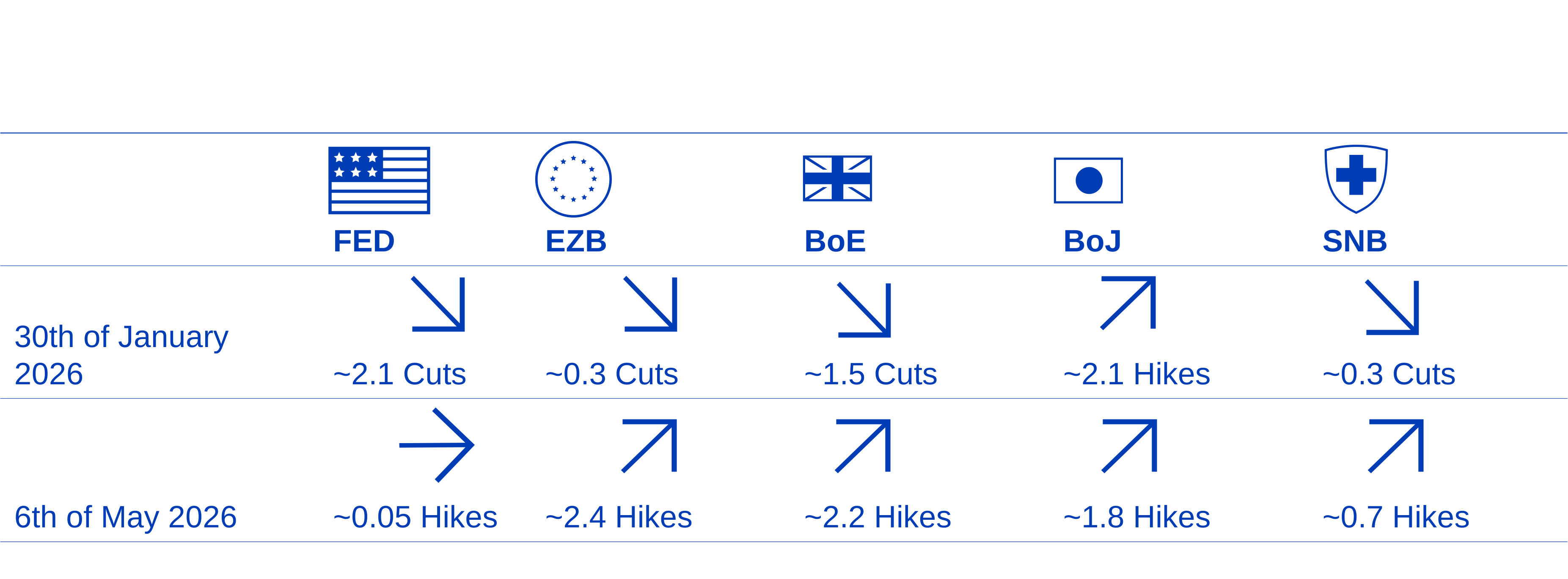
Turning points compared: How rates markets in 2026 differ from 2022
The current situation is markedly different from the conditions in 2022 during the COVID-19 crisis. Supply chains are more resilient today, and central banks are starting from an already restrictive interest rate environment. While significant rate hikes were needed in 2022 to achieve a neutral monetary policy, we are already in a slightly restrictive environment in 2026. Financial conditions also appear significantly tighter than they were back then.
The current pricing of rate hikes suggests to us that the market may have reached a new equilibrium – a view supported by stable long-term inflation risk premiums, despite the recent surge in energy prices.
Where caution is needed in rates markets – and where opportunities lie
How can investors respond to such an environment? In our view, short-term USD bonds still offer attractive investment opportunities. Treasuries remain among the most liquid assets in the bond universe – and this liquidity can be highly valuable, especially in a volatile environment. It allows investors to act quickly when opportunities arise. Additionally, we find the current interest rate levels – particularly at the short end of the curve – to be attractive. We see potential to benefit from the increased current yields.
European bonds are also likely to reach their yield peaks. This is despite the fact that the ECB will likely maintain a cautious stance for longer due to the delayed impact of the energy crisis on inflation figures. We see some renewed value in peripheral bonds but recommend staying close to the benchmark duration in EUR. Additionally, we have built smaller positions in CHF and CAD, which represent lower-beta options. In Europe, however, we are gradually reducing positions in inflation-linked bonds, or linkers, while continuing to increase longer-dated linkers in the U.S.
Should the Fed shift its focus more towards the labour market in this environment, long-term inflation expectations in the U.S. could also rise. It is important to note that linkers trade on inflation expectations rather than current inflation – an aspect that makes the Fed appear less restrictive than the ECB.
Emerging markets worth considering
For more risk-tolerant investors, adding emerging market debt (EMD) to their portfolios could also be worthwhile. These bonds typically offer higher real yields and stable currencies, which could outperform developed markets. For instance, we had already added Hungarian and Mexican bonds to our portfolios before the outbreak of the conflict.
However, some caution is warranted: our strategy assumes that commodity markets will stabilise in the coming weeks and reach a “new normal.” If the conflict escalates further and commodity prices trigger second-round effects, we will reassess the situation promptly.
Funds in the spotlight
Funds in the spotlight
Legal notices
Legal notices
Legal information regarding the charts:
“BLOOMBERG®” and the Bloomberg indices listed herein (the “Indices”) are service marks of Bloomberg Finance L.P. and its affiliates, including Bloomberg Index Services Limited (“BISL”), the administrator of the Indices (collectively, “Bloomberg”) and have been licensed for use for certain purposes by the distributor hereof (the “Licensee”). Bloomberg is not affiliated with Licensee, and Bloomberg does not approve, endorse, review, or recommend the financial products named herein (the “Products”). Bloomberg does not guarantee the timeliness, accuracy, or completeness of any data or information relating to the Products.
Legal notice
This document is for information and advertising purposes only. It is intended for distribution in Switzerland and is not intended for investors in other countries.
It does not constitute an offer or a recommendation to purchase, hold or sell financial instruments or to obtain products or services, nor does it form the basis for a contract or an obligation of any kind. The recipient is advised to review the information, possibly with the assistance of an advisor, to determine its compatibility with their personal circumstances as well as its legal, regulatory, tax, and other implications. The information contained in this publication may be adjusted at any time.
The document was prepared by Zürcher Kantonalbank with customary due diligence and may contain information from carefully selected third-party sources. However, Zürcher Kantonalbank provides no warranty as to the correctness and completeness of the information contained therein and accepts no liability for damages resulting from the use of the document or information contained therein.
Unless otherwise stated, the information refers to Zürcher Kantonalbank's asset management under the Swisscanto brand, which primarily includes collective capital investments under Swiss, Luxembourg and Irish law (hereinafter referred to as "Swisscanto funds").
The investment opinions and assessments of securities and/or issuers contained in this document have not been prepared in accordance with the rules on the independence of financial analysts and therefore constitute marketing communications (and not independent financial analysis). In particular, the employees responsible for such opinions and assessments are not necessarily subject to restrictions on trading in the relevant securities and may in principle conduct their own transactions or transactions for Zürcher Kantonalbank in these securities.
The sole binding basis for purchasing Swisscanto funds is the current fund documents (e.g. fund agreements/contractual conditions, prospectuses, key investor information or basic information sheets as well as annual reports), which can be obtained from products.swisscanto.com/, Swisscanto Fund Management Company Ltd., Bahnhofstrasse 9, CH-8001 Zurich (also representative of the Luxembourg Swisscanto funds) or from all branch offices of Zürcher Kantonalbank. The paying agent for the Luxembourg Swisscanto funds in Switzerland is Zürcher Kantonalbank, Bahnhofstrasse 9, CH-8001 Zurich.
Carne Global Fund Managers (Schweiz) AG is the representative for funds domiciled in Ireland. Zürcher Kantonalbank is the paying agent for the Irish Swisscanto funds in Switzerland and Luxembourg funds.
It should be noted that any information about historical performance does not indicate current or future performance, and any performance data provided may not consider the commissions and costs incurred when issuing and redeeming fund units. Any estimates regarding future returns and risks contained in the document are for informational purposes only. Zürcher Kantonalbank does not provide any guarantee for this.
Every investment involves risks, especially with regard to fluctuations in value and return.
In terms of any sustainability information, please note that there is no generally accepted framework or list of factors in Switzerland that has to be considered in order to ensure the sustainability of investments.
For Irish and Luxembourgish Swisscanto funds, information on sustainability-related aspects in accordance with the Disclosure Regulation (EU) 2019/2088 is available at products.swisscanto.com/.
The products and services described in this publication are not available to US persons in accordance with the applicable regulations. This publication and the information contained in it must not be distributed and/or redistributed to, used or relied upon by, any person (whether individual or entity) who may be a US person under Regulation S of the US Securities Act of 1933. US persons include any US resident; any corporation, company, partnership or other entity organized under any law of the United States; and other categories set out in Regulation S. Status of the data (unless otherwise stated): 03.2025
© 2026 Zürcher Kantonalbank. All rights reserved.