What the 2025 Economics Nobel Prize reveals about thematic investments
The 2025 Nobel Prize in Economic Sciences was awarded for theories describing how competition and innovation drive technological progress. Cezara Lozneanu and Dr. Gerhard Wagner explain how to identify companies that embrace this creative destruction and achieve profitable growth.
Autoren: Cezara Lozneanu and Dr Gerhard Wagner

Key points on innovation and growth:
- Innovation and competition drive growth: The theories of Nobel laureates Aghion, Howitt, and Mokyr demonstrate that technological progress, driven by innovation, competition, and the renewal of existing structures, fuels long-term economic growth.
- Thematic investments benefit from innovation: Structural trends, such as digitalisation, offer long-term return opportunities when companies successfully leverage innovation and achieve profitable growth.
- Analysis and capital efficiency are crucial: To identify the winners of structural change, fundamental analysis and key metrics are essential to pinpoint innovative and competitive companies.
The year 2025 was marked by multiple disruptive developments. On the economic front, investments and advancements in Artificial Intelligence (AI) have continued to contribute to economic growth. They have also driven the U.S. equity markets, with the top 30 AI companies contributing to around 60% of the total earnings growth of the S&P 500 Index, according to the «2026 Global Equity Outlook» the U.S. investment bank J.P. Morgan published last November.
At the same time, the global order moved rapidly away from globalization toward a multipolar geopolitical environment. In the US, the independence of educational institutions and sustainability efforts came under pressure.
Against this backdrop, the research topic honoured with the Nobel Prize in Economic Sciences in October 2025 could not have been more fitting: growth through innovation and creative destruction.
Nobel Prize in economic sciences: A summary of the theories
The Nobel Prize was awarded to Philippe Aghion, Peter Howitt, and Joel Mokyr. In 1992, Aghion and Howitt proposed a model that describes how technological progress arises from competition and innovation, fosters overall economic growth, creates opportunities for new market entrants, and challenges established companies that fail to adapt. Economist Joel Mokyr's research is complementary, showing societies that promote scientific curiosity, open exchange, and experimentation tend to achieve higher levels of innovation and productivity. In short, the Nobel laureates showed that long-term and sustainable economic growth is not solely driven by capital accumulation but also depends on maintaining mechanisms that support adaptation and the continuous replacement of old technologies with new ones. Together, the work of the Nobel prize laureates offers a coherent framework for understanding how technological progress, entrepreneurship, and competition drive economic growth within a supportive institutional environment.
A prime example of the Nobel Prize theory: The U.S. economic exceptionalism
The unique economic position the United States has held over the past decades we believe exemplifies this. Over recent decades, innovation in the United States has remained close to the global technological frontier, supported by a strong university system, close links between academia and industry, and a business environment conducive to experimentation and scale.
Economic growth – a comparison of countries (average GDP growth in %)
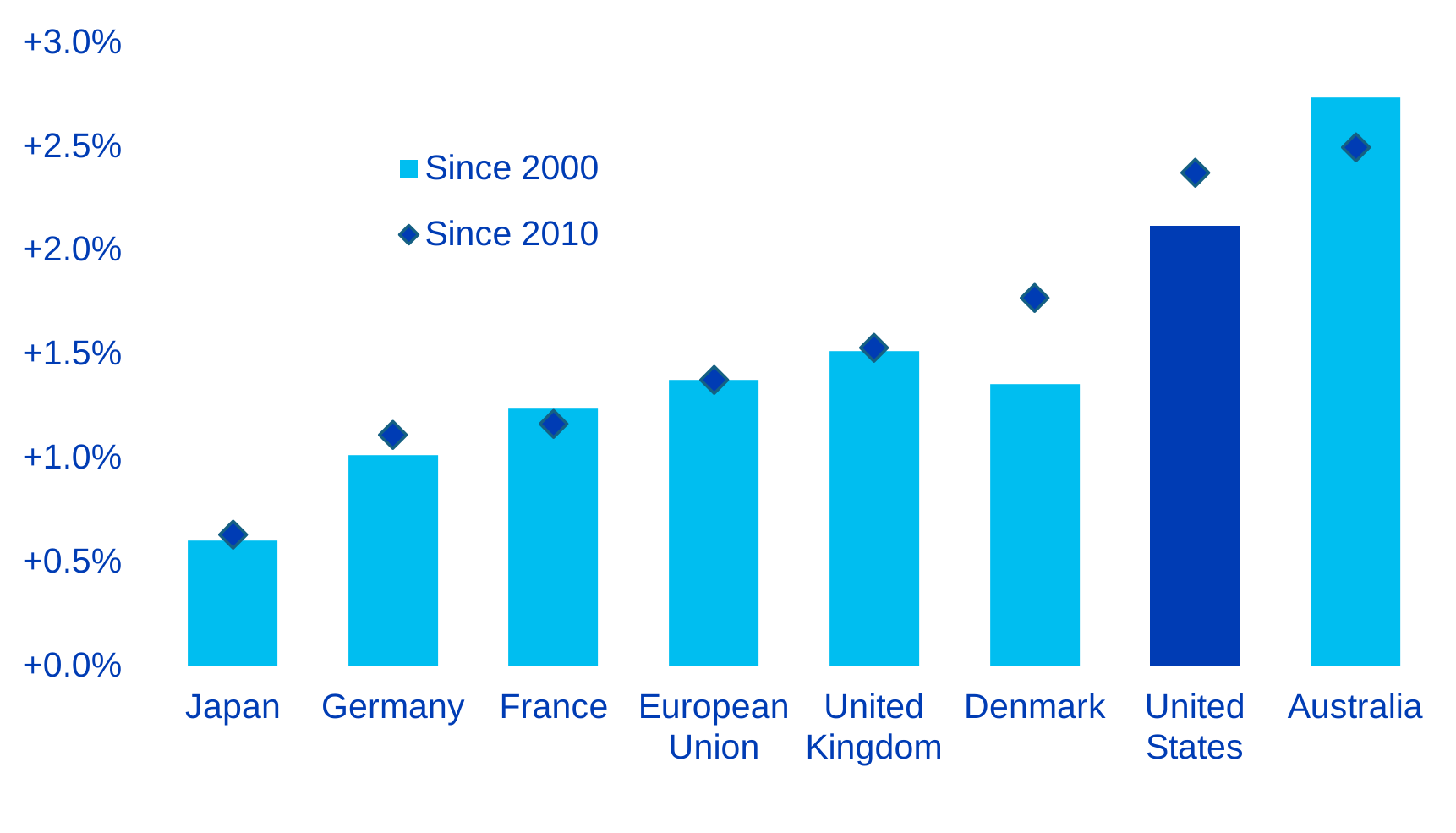
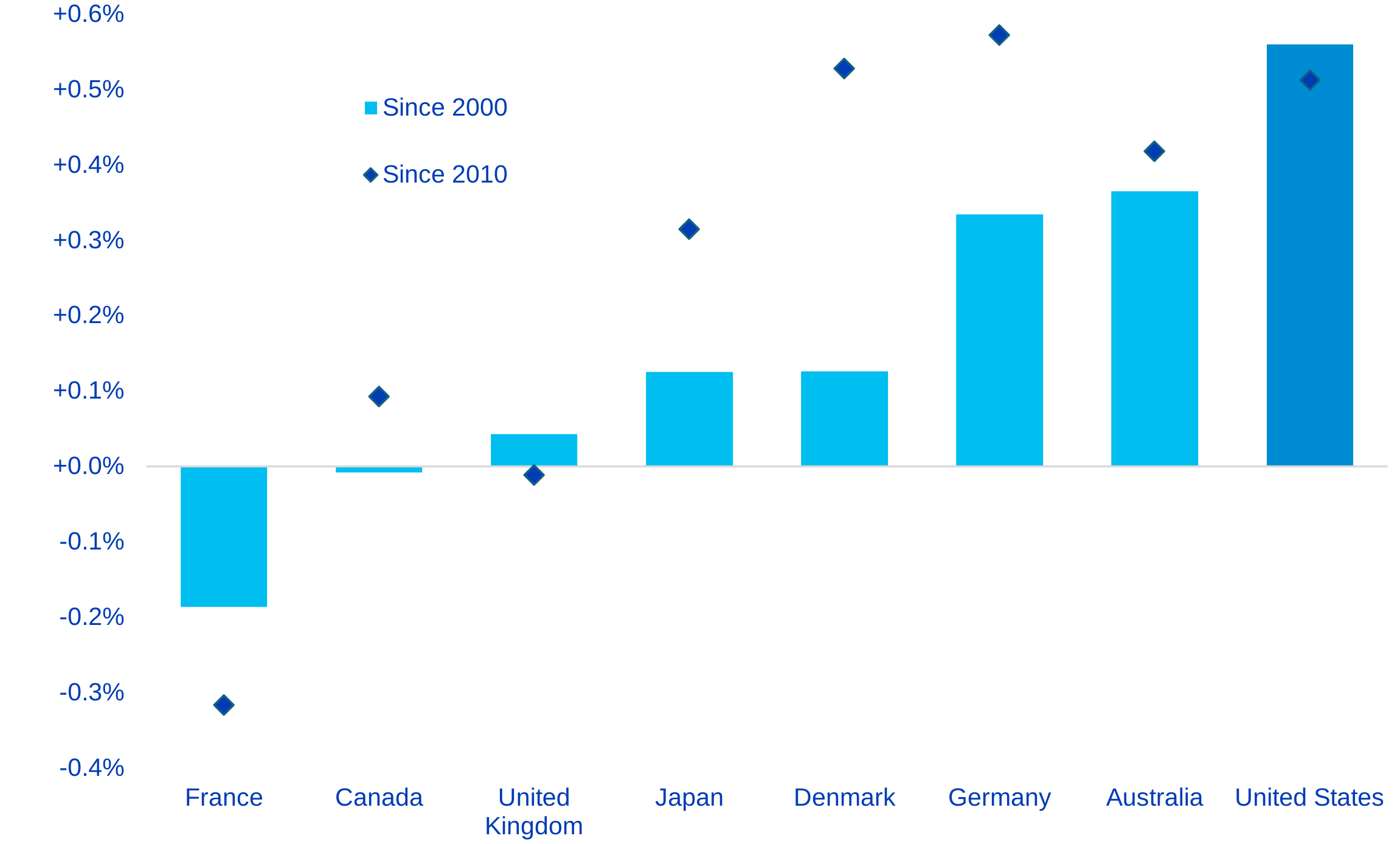
As a result, productivity gains – measured by higher total factor productivity (TFP, the portion of economic growth driven by technological progress, innovation, and efficiency improvements) – have played a key role in driving economic growth in the US compared to other developed economies (see charts above and below).
U.S. leading in total factor productivity (TFP) growth (Average TFP Growth in %)
Why the Nobel laureates' insights are relevant for thematic investors
These insights stemming from the work of Aghion, Howitt, and Mokyr are highly relevant for investors seeking long-term and sustainable thematic investment opportunities. To achieve this, investors must identify structural trends where innovation-driven change can create long-term above-average growth. Specifically, it is crucial to pinpoint companies that have "creative destruction" on their side and can achieve profitable growth. We see these prerequisites in megatrends such as Circular Economy, Water Conservation, Climate and Energy Transition, Healthy Longevity, and Digital Economy. In our view, innovations in these areas hold long-term potential to transform industries and value chains, offering attractive investment opportunities.
This potential is already evident in the innovations that have driven digitalization over the past 30 years, underpinned by massive investments in research and development. They have been changing global industries and created new markets with high return potential.
Numerous opportunities to benefit from the Nobel Prize theory of growth through innovation
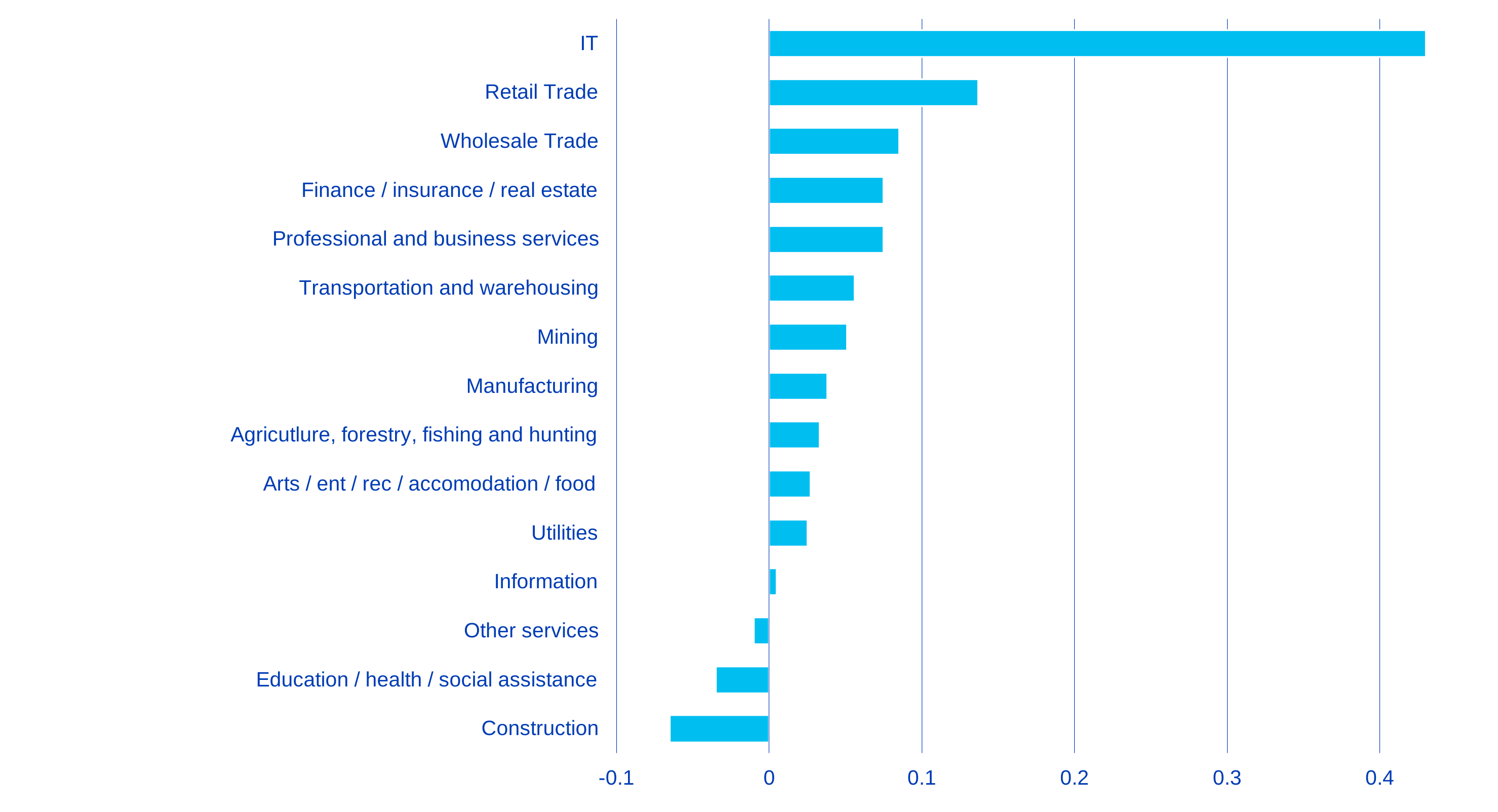
As Microsoft CEO Satya Nadella stated in 2020, the share of GDP spent on technology could double over the next decade. The AI revolution has the potential of increasing this prediction. At a macro level, the IT sector alone has been responsible for roughly 45% of TFP growth over the past 40 or so years (see chart below), though its share of the U.S. economy’s total production of goods and services in the private business sector (measured as either gross output or value added) averaged only about 8% during this period.
Investments in the IT sector as a driver of economic growth in the U.S. (Sector Contributions to TFP Growth in %)
Thus, for thematic investors, this Nobel prize does not only celebrate academic achievement but also validates an investment philosophy which focuses on quality and growth within innovation-driven themes. Economic progress is not uniform; it depends on the ability of firms to innovate, adapt, and deploy capital efficiently.The equity markets offer plentiful opportunities to capture the economic upside of innovation. However, often times the most innovative companies are in the small- and mid-cap space, and identifying the winners requires understanding how structural themes translate into corporate performance. Companies with strong innovation pipelines, high barriers to entry, and durable business models tend to achieve superior returns on invested capital (ROIC) and sustain growth through cycles of disruption.
How to identify leading companies
Selecting the firms that lead or successfully adapt to innovation—while avoiding those left behind—is therefore essential. In our view, this involves:
- Understanding structural themes that represent the current engines of creative destruction, such as digitalisation, energy transition, demographic shifts, and resource efficiency.
- Assessing firm quality beyond innovation alone: operating environment, regulatory stability, ability to protect intellectual property, managerial execution, and scalability all determine whether innovation translates into financial returns.
- Monitoring capital efficiency through ROIC, a key indicator of a company’s discipline, adaptability, and competitive strength.
- Maintaining perspective amid short-term market cycles, which often alternate between over-excitement and scepticism toward new technologies.
Nobel Prize theory in practice: Fundamental research and disciplined risk management are key
The Nobel Prize also highlights the importance of micro-level analysis. In the laureates’ models, growth emerges from firm-level decisions about innovation and competition. Likewise, in investing, understanding company fundamentals is essential to distinguishing between those driving structural change and those being disrupted by it.
The Asset Management of Zürcher Kantonalbank, which manages the sustainable Swisscanto thematic funds, sees this as validation of an approach that combines thematic awareness with rigorous bottom-up research (see info box below).
Why creative destruction supports active management
The thematic investment teams at the Asset Management of Zürcher Kantonalbank actively integrate academic knowledge and insights from professional forums into our investment process. They systematically monitor scientific literature, participate in expert conferences, and closely follow developments in climate research. Additionally, they leverage expert networks to review and challenge investment assumptions.
Rather than relying on general narratives, the thematic teams focus on evaluating strategy, capital allocation, innovation culture, and financial resilience. This approach aims to identify companies capable of generating value over time. It contrasts with a passive engagement in themes or sectors, which often fails to distinguish between companies driving change and those merely affected by it.
A disciplined risk management approach remains a cornerstone of this strategy. While innovation creates opportunities, it also introduces uncertainties. By adhering to valuation discipline and ensuring diversification, the approach guarantees that exposure to structural growth remains both sustainable and resilient.
Our Conclusion
The 2025 Nobel Prize underscores that sustained growth—whether in economies or portfolios—depends on innovation, adaptability, and sound execution. For investors, the message is clear: themes provide the direction, but fundamentals determine the outcome. At Swisscanto we have identified and invest in 5 themes, where we see that Innovation leads to above average growth rates: Circular Economy, Water Conservation, Climate and Energy Transition, Healthy Longevity, and Digital Economy.
Legal disclaimer Switzerland
Legal disclaimer Switzerland
This document only serves advertising and information purposes, is for distribution in Switzerland only and is not directed at persons in whose nationality or place of residence prohibit access to such information under applicable law. Where not indicated otherwise, the information concerns the collective investment schemes under the law of Luxembourg managed by Swisscanto Asset Management International S.A. (hereinafter "Swisscanto Funds"). The products described are undertakings for collective investment in transferable securities (UCITS) within the meaning of EU Directive 2009/65/EC, which is governed by Luxembourg law and subject to the supervision of the Luxembourg supervisory authority (CSSF). This document does not constitute a solicitation or invitation to subscribe or make an offer to purchase any securities, nor does it form the basis of any contract or obligation of any kind. The sole binding basis for the acquisition of Swisscanto Funds are the respective legal documents (management regulations, sales prospectuses and key information documents (PRIIP KID), as well as financial reports), which can be obtained free of charge at https://products.swisscanto.com as well as at Swisscanto Fondsleitung AG, Bahnhofstrasse 9, CH-8001 Zurich (also acting as representative of the Luxembourg Swisscanto funds in Switzerland) or in all offices of Zürcher Kantonalbank. Paying Agent for the Luxembourg Swisscanto funds in Switzerland is Zürcher Kantonalbank, Bahnhofstrasse 9, CH-8001 Zurich. Information about the sustainability-relevant aspects in accordance with the Regulation (EU) 2019/2088 as well as Swisscanto's strategy for the promotion of sustainability and the pursuit of sustainability goals in the fund investment process are available on the same website. The sub-fund referred to in the document is subject to Article 9 of Regulation (EU) 2019/2088. The distribution of the fund may be suspended at any time. Investors will be informed about the deregistration in due time. The investment involves risks, in particular those of fluctuations in value and earnings. Investments in foreign currencies are subject to exchange rate fluctuations. Past performance is neither an indicator nor a guarantee of future success. The risks are described in the sales prospectus and in the PRIIP KID. The information contained in this document has been compiled with the greatest care. Despite professional procedures, the correctness, completeness and topicality of the information cannot be guaranteed. Any liability for investments based on this document will be rejected. The document does not release the recipient from his or her own judgment. In particular, the recipient is recommended to check the information for compatibility with his or her personal circumstances as well as for legal, tax and other consequences, if necessary, with the help of an advisor. The prospectus and PRIIP KID should be read before making any final investment decision. The products and services described in this document are not available to U.S. persons under the relevant regulations (in particular Regulation S under the U.S. Securities Act of 1933).
Data as at (where not stated otherwise): 11.2024
© Zürcher Kantonalbank. All rights reserved.
Legal disclaimer international
Legal disclaimer international
This document only serves advertising and information purposes and is not directed at persons in whose nationality or place of residence prohibit access to such information under applicable law. Where not indicated otherwise, the information concerns the collective investment schemes under the law of Luxembourg managed by Swisscanto Asset Management International S.A. (hereinafter "Swisscanto Funds"). The products described are undertakings for collective investment in transferable securities (UCITS) within the meaning of EU Directive 2009/65/EC, which is governed by Luxembourg law and subject to the supervision of the Luxembourg supervisory authority (CSSF).
This document does not constitute a solicitation or invitation to subscribe or make an offer to purchase any securities, nor does it form the basis of any contract or obligation of any kind. The sole binding basis for the acquisition of Swisscanto Funds are the respective published legal documents (management regulations, sales prospectuses and key information documents (PRIIP KID), as well as financial reports), which can be obtained free of charge at https://products.swisscanto.com/. Information about the sustainability-relevant aspects in accordance with the Regulation (EU) 2019/2088 as well as Swisscanto's strategy for the promotion of sustainability and the pursuit of sustainability goals in the fund investment process are available on the same website. The sub-fund referred to in the document is subject to Article 9 of Regulation (EU) 2019/2088.
The distribution of the fund may be suspended at any time. Investors will be informed about the deregistration in due time. The investment involves risks, in particular those of fluctuations in value and earnings. Investments in foreign currencies are subject to exchange rate fluctuations. Past performance is neither an indicator nor a guarantee of future success. The risks are described in the sales prospectus and in the PRIIP KID. The information contained in this document has been compiled with the greatest care. Despite professional procedures, the correctness, completeness and topicality of the information cannot be guaranteed. Any liability for investments based on this document will be rejected. The document does not release the recipient from his or her own judgment. In particular, the recipient is recommended to check the information for compatibility with his or her personal circumstances as well as for legal, tax and other consequences, if necessary, with the help of an advisor. The prospectus and PRIIP KID should be read before making any final investment decision.
An overview of investors' rights is available at https://www.swisscanto.com/int/en/legal/summary-of-investor-rights.html.
The products and services described in this document are not available to U.S. persons under the relevant regulations (in particular Regulation S under the U.S. Securities Act of 1933). Data as at (where not stated otherwise): 11.2024
© Zürcher Kantonalbank. All rights reserved.