AI euphoria under scrutiny – opportunities remain intact
The recent price corrections in the technology sector have indeed abruptly put the AI euphoria on hold, but they are more likely to mark an advanced correction than the start of a longer, recession-driven downward trend.

- The stock market turbulence, which began in October with a rotation out of IT companies into defensive sectors, has intensified since then and broadened to large parts of the market. We view this as an advanced correction rather than the start of a recessionary bear market.
- We see three main drivers that have become more acute: Firstly, significantly lower AI earnings expectations (fears of overcapacity, doubts about financing and turbulence at Nvidia). Secondly, technical chain reactions (due to leveraged products and market concentration). Thirdly, an overly restrictive US Federal Reserve from the market's perspective.
- Despite heightened uncertainty, the fundamental outlook remains in our view constructive overall. From a European multi-asset perspective, the portfolio has been supported this year by the Euro Stoxx Index at +5.4% and the S&P 500 at +8.5% (in CHF), thanks to the strong US dollar.
- Our tactics remain: US Treasuries as a stabiliser, and selectively exploiting opportunities in equities.
What has happened?
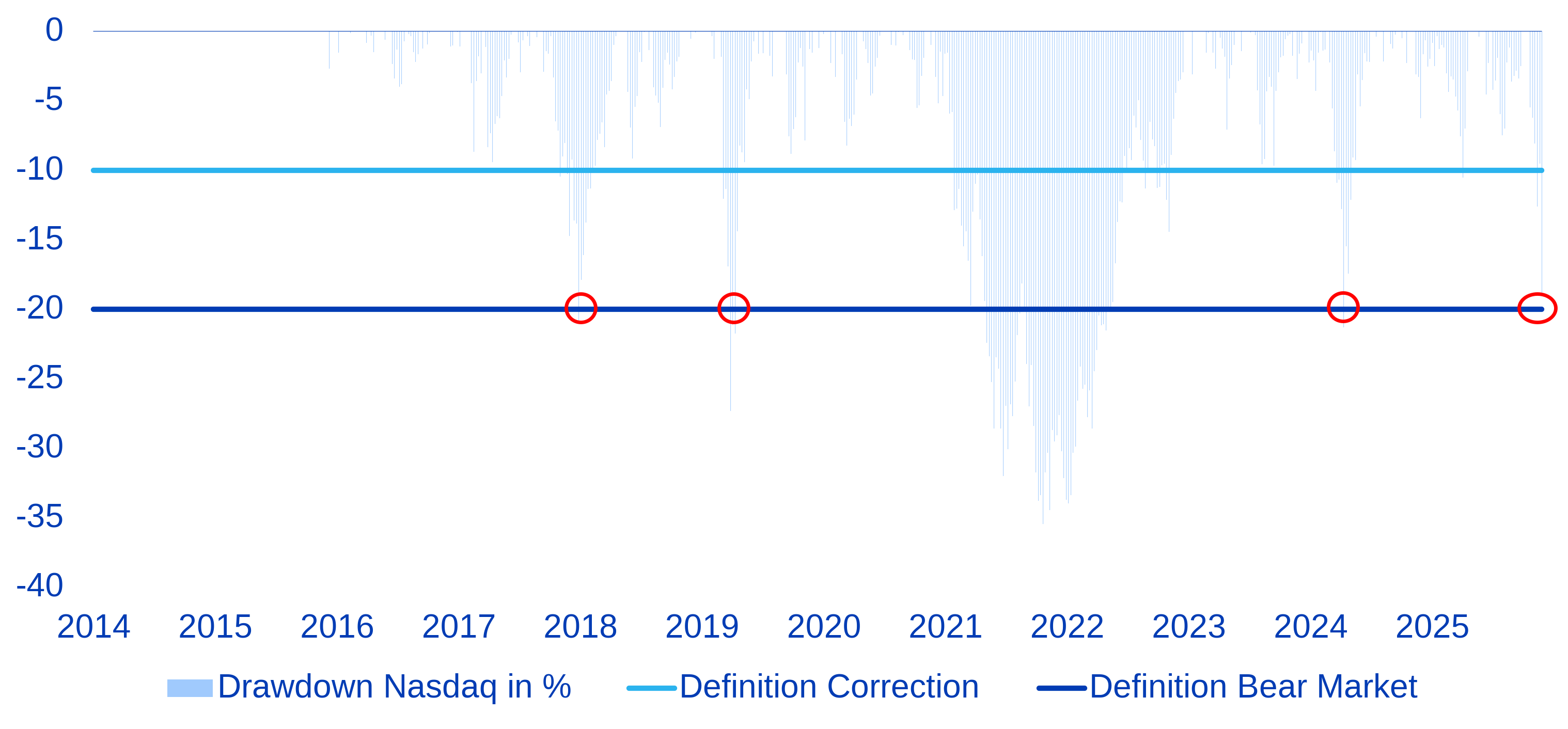
Since its peak on 6 October, the technology index Nasdaq has lost just under 20% and is now trading even below its level at the beginning of the year, although aggregate corporate earnings in the sector have risen by around 50% over the same period. Since early June, this has built into a pronounced correction that accelerated sharply in October. The decline intensified again over the past week, even though two prominent AI flagships delivered positive news: Nvidia was able to double its quarterly profit to USD 65 billion and Anthropic completed a successful IPO.
The recent losses were further fueled by technical chain reactions (leveraged products and concentrated positions) and fears of an overly restrictive monetary policy by the US central bank. Notably, even classic safe havens or alternative investments such as gold, bitcoin and commodities came under pressure. Among the few winners of the recent market dislocations were government bonds and the US dollar. The dynamics and the sell-off last Friday suggest that from our perspective, we are in an advanced cleansing phase.
How are the markets reacting?
|
Market |
Price change |
Price change |
Price change |
|---|---|---|---|---|
| Energy | Oil (Brent) |
-5.6% |
52.0% |
60.7% |
| Metals | Gold |
-12.9% |
-16.3% |
-11.4% |
| Currencies | USDCHF |
0.5% |
5.7% |
|
USDEUR |
3.1% |
6.7% |
||
| Equities | MSCI EM Future |
-17.0% |
0.7% |
6.4% |
USA Future |
-8.2% |
2.8% |
8.6% |
|
Nasdaq Future |
-15.6% |
1.8% |
7.6% |
|
US Semiconductor |
-34.9% |
22.9% |
30.1% |
|
Europe Future |
-5.1% |
2.3% |
1.5% |
|
Switzerland Future |
5.1% |
10.3% |
||
| Interest rates | US 10 Year |
-34.1 Bps. |
+77.7 Bps. |
|
EUR 10 Year |
-28.2 Bps. |
+44.9 Bps. |
||
| Volatility | VIX |
+19.6 Points |
+20.9 Points |
|
Source: Bloomberg, Zürcher Kantonalbank as at 23.11.2026, 07:00
How do we assess the situation?
Investment in AI is enormous and will, in our view, probably take longer before returns justify the high upfront costs. Financing is being provided through lower free cash flows, higher debt in the bond market and in private markets, as well as through partially complex ownership structures. All of these are legitimate reasons for increased caution.
At the same time, we continue to view the companies’ long-term growth prospects as very strong. However, expectations regarding future profitability are already ambitious. It is increasingly crucial to what extent the substantial investments translate into sustainable earnings. The next phase of the AI boom is likely to lie primarily with the traditional users of the technology who deploy AI productively. The market has recently increased the risk premium for this uncertainty significantly.
Compared with the tech bubble of 1999, today’s corporate earnings are significantly higher; accordingly, the valuation at around 16x P/E in the US market is moderate. Technical and sentiment indicators, such as elevated volatility and position reductions by technology-focused hedge funds, point to an advanced cleansing phase, while low cash levels and support zones that have not yet been firmly established signal further downside risk.
Supportive factors include the fact that the global economy is in an expansion phase, and inflation rates are expected to cool next year, according to our assessment. Overall, we therefore see more scope for selectively adding risk than signs of the onset of a structural bear market.
Drawdown of the Nasdaq Index
In the absence of a pronounced economic downturn, a loss of more than 20% in the Nasdaq appears historically unlikely.
How is our investment strategy performing?
In recent weeks, both relative and absolute returns have temporarily suffered from broader risk aversion in the markets. Our overweight in technology and emerging markets, which have corrected particularly sharply in the current environment, has been the main drag, but also reflects our focus on long-term growth drivers.
We see it as positive that we deliberately reduced overall risk at the end of October: the gradual reduction of equities and silver, as well as the targeted build-up of government bonds as a "bodyguard" in the portfolio, has proved effective. Government bonds, the US dollar and alternative investments such as cat bonds have made an important stabilising contribution and cushioned setbacks in the riskier segments.
Legal information on the charts
Legal information on the charts
“BLOOMBERG®” and the Bloomberg indices listed herein (the “Indices”) are service marks of Bloomberg Finance L.P. and its affiliates, including Bloomberg Index Services Limited (“BISL”), the administrator of the Indices (collectively, “Bloomberg”) and have been licensed for use for certain purposes by the distributor hereof (the “Licensee”). Bloomberg is not affiliated with Licensee, and Bloomberg does not approve, endorse, review, or recommend the financial products named herein (the “Products”). Bloomberg does not guarantee the timeliness, accuracy, or completeness of any data or information relating to the Products.
Legal notice Switzerland
Legal notice Switzerland
This document is for information and advertising purposes only. It is intended for distribution in Switzerland and is not intended for investors in other countries.
It does not constitute an offer or a recommendation to purchase, hold or sell financial instruments or to obtain products or services, nor does it form the basis for a contract or an obligation of any kind. The recipient is advised to review the information, possibly with the assistance of an advisor, to determine its compatibility with their personal circumstances as well as its legal, regulatory, tax, and other implications. The information contained in this publication may be adjusted at any time.
The document was prepared by Zürcher Kantonalbank with customary due diligence and may contain information from carefully selected third-party sources. However, Zürcher Kantonalbank provides no warranty as to the correctness and completeness of the information contained therein and accepts no liability for damages resulting from the use of the document or information contained therein.
Unless otherwise stated, the information refers to Zürcher Kantonalbank's asset management under the Swisscanto brand, which primarily includes collective capital investments under Swiss, Luxembourg and Irish law (hereinafter referred to as "Swisscanto funds").
The investment opinions and assessments of securities and/or issuers contained in this document have not been prepared in accordance with the rules on the independence of financial analysts and therefore constitute marketing communications (and not independent financial analysis). In particular, the employees responsible for such opinions and assessments are not necessarily subject to restrictions on trading in the relevant securities and may in principle conduct their own transactions or transactions for Zürcher Kantonalbank in these securities.
The sole binding basis for purchasing Swisscanto funds is the current fund documents (e.g. fund agreements/contractual conditions, prospectuses, key investor information or basic information sheets as well as annual reports), which can be obtained from products.swisscanto.com/, Swisscanto Fund Management Company Ltd., Bahnhofstrasse 9, CH-8001 Zurich (also representative of the Luxembourg Swisscanto funds) or from all branch offices of Zürcher Kantonalbank. The paying agent for the Luxembourg Swisscanto funds in Switzerland is Zürcher Kantonalbank, Bahnhofstrasse 9, CH-8001 Zurich.
Carne Global Fund Managers (Schweiz) AG is the representative for funds domiciled in Ireland. Zürcher Kantonalbank is the paying agent for the Irish Swisscanto funds in Switzerland and Luxembourg funds.
It should be noted that any information about historical performance does not indicate current or future performance, and any performance data provided may not consider the commissions and costs incurred when issuing and redeeming fund units. Any estimates regarding future returns and risks contained in the document are for informational purposes only. Zürcher Kantonalbank does not provide any guarantee for this.
Every investment involves risks, especially with regard to fluctuations in value and return.
In terms of any sustainability information, please note that there is no generally accepted framework or list of factors in Switzerland that has to be considered in order to ensure the sustainability of investments.
For Irish and Luxembourgish Swisscanto funds, information on sustainability-related aspects in accordance with the Disclosure Regulation (EU) 2019/2088 is available at products.swisscanto.com/.
The products and services described in this publication are not available to US persons in accordance with the applicable regulations. This publication and the information contained in it must not be distributed and/or redistributed to, used or relied upon by, any person (whether individual or entity) who may be a US person under Regulation S of the US Securities Act of 1933. US persons include any US resident; any corporation, company, partnership or other entity organized under any law of the United States; and other categories set out in Regulation S. Status of the data (unless otherwise stated): 03.2025