Why grid infrastructure is of high-voltage interest for investors
The expansion of renewable energies and electrification is accelerating. However, this trend is being hindered by inadequate and outdated grid infrastructure. Significant investment is planned to address this issue. In turn, this could generate high-voltage opportunities from a sustainable investment perspective, as Dr Daniel Zimmerer and Dr Gerhard Wagner explain.
Authors: Dr Gerhard Wagner and Dr Daniel Zimmerer

The key points on the investment potential of grid infrastructure:
- Energy transition, technological progress (for example data centres and electric vehicles) and security of supply are driving forces behind the expansion of grid infrastructure. At present, both the supply of and demand for electricity are encountering inadequate grid infrastructure in many places.
- Renewable energies and electrification are regarded as some of the most cost-effective and energy-efficient ways to decarbonise the economy. Both technology trends also enhance security of supply, but they depend on a robust grid infrastructure.
- Our investment focus in the area of grid infrastructure is on high-voltage infrastructure, power transformers, power cables and distribution grids. Alongside the long-term opportunities, potential risks must also be borne in mind: for example, changes in the geopolitical and technological environment and market volatility.
Secure access to energy is electrifying. In the US, high petrol and diesel prices have become a decisive factor in the midterm elections. In Europe, the EU is rapidly driving forward the "Electrification Action Plan". And here in Switzerland, the Federal Parliament adopted two laws within just a few months to accelerate the authorisation of new power generation plants and grid networks (see info box below).
“Electro-continent” planning billions in investment in grid infrastructure
The conflict in the Middle East has acted as a definitive wake-up call for policymakers and authorities. According to experts, its consequences have led to the greatest supply shock ever seen in oil and liquefied gas. Europe is also feeling the impact. As Commission President Ursula von der Leyen explained in her State of the Union address last September, the EU paid an additional EUR 90 billion for the import of fossil fuels as a result of price increases. Overall, imports have already cost well over EUR 200 billion since the beginning of the year.
This reinforces the EU’s plan to halve spending on fossil fuels by 2040 and replace them with clean electricity from domestic production. Europe would thus become the world’s first “electro-continent”.
Grid infrastructure today: outdated, fragmented and poorly aligned with renewables
However, there is a major obstacle to this vision in the EU: the planned capacity expansion of around 480 gigawatts (GW) in renewable energies is up against grid infrastructure that is outdated, shaped by national interests and poorly aligned with increasingly decentralised power generation and the rising electricity demand of the future. It is clear that this is also a global issue: in many parts of the world, rising demand for electricity is encountering inadequate grid infrastructure.
As the International Energy Agency (IEA) has calculated, global demand for electricity is expected to increase by an average of 3.6% per year up to 2030, driven by rising consumption in industry and by electric vehicles, climate-control technologies and data centres for artificial intelligence (AI). Even taking efficiency gains into account, that would be more than the expected global economic growth of 2 to 3 per cent and 50 per cent higher than the growth in electricity demand over the past decade.
Clear track for the Swiss “Grid Express”
Ensuring security of electricity supply is also a high political priority in Switzerland. A federal decree adopted by the Federal Assembly back in September 2025, aimed at the domestic market, is intended to accelerate approval procedures for new power-generation plants. The law focuses primarily on renewable energies such as solar and wind power.
Last October, the Federal Assembly passed the law on “accelerating the expansion and conversion of the electricity grids”, the so-called “Grid Express” (Netzexpress). As with generation plants, approvals for the replacement and expansion of high-voltage and distribution grids in Switzerland are to be improved. This is also intended to take account of the more decentralised electricity production of the future. The law also introduces simplifications for the construction of transformers and battery storage stations.
The the Federal Assembly is not expected to present the draft amendments to the laws required for the implementation of the electricity agreement with the EU before the end of 2026 at the earliest. The focus here is on better and more efficient integration of Switzerland into the European grid, with the emphasis again on security of supply – particularly on electricity imports in winter. Likely, and at the earliest in 2027, the proposal will then be put before the Swiss electorate.
A potential bottleneck is also emerging on the supply side. Worldwide, renewable energy projects with a planned total capacity of around 2,300 GW are waiting to be connected to the grid. This is also significant from a sustainability perspective: without expanding the power grid, even a fully built-out fleet of renewable energy generation plants cannot exploit its decarbonisation potential.
Energy transition, technology and security of supply as drivers of grid infrastructure
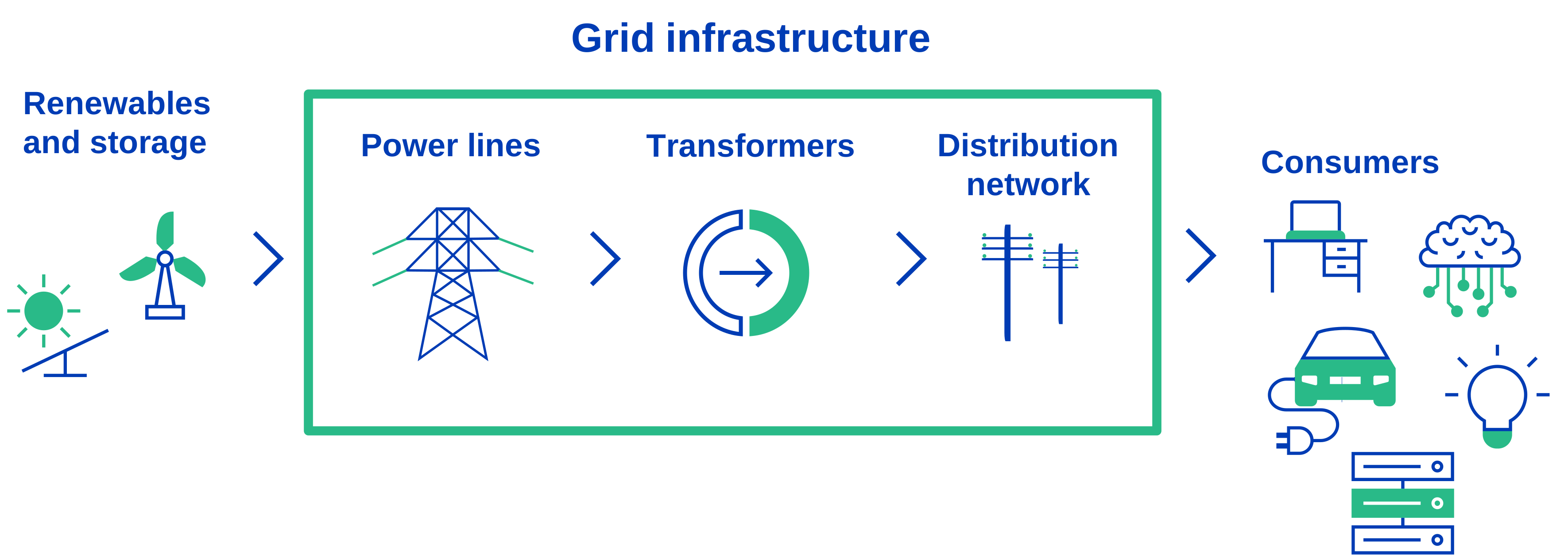
In short, grid infrastructure is proving to be a real bottleneck for the trend towards electrification (see chart below). Insufficient expansion could have adverse effects at several levels: on security of supply, on technological development and on the energy transition, which is so vital for climate protection. The combination of renewables and electrification is therefore often seen as a key, cost-efficient decarbonisation strategy. This is because electrical technologies are more energy-efficient than their combustion-based counterparts and reduce dependence on expensive imported fossil fuels.
It is easy to see that this will give rise to an enormous need for investment in grid infrastructure over the coming years. In the EU alone, Commission President von der Leyen called emphatically last September for EUR 3.2 trillion to be invested in power generation, power grids and storage capacity.
Rapid increase in power demand and supply puts the spotlight on grid infrastructure
Where we are focusing in grid infrastructure
While governments are able to spend with a broad brush, we are taking a clearly selective approach in our active investments in grid infrastructure: as part of our sustainable global equity strategy and our thematic fund focused on climate protection and the energy transition, we concentrate on companies that, in our view, offer above-average growth prospects and attractive opportunities for returns on capital.
We are focusing on the following areas:
- Power lines: We consider equipment for high-voltage transmission grids particularly interesting from an investment perspective. High-voltage infrastructure is likely to benefit directly from the EU’s ambitious electrification agenda; the plans for European transmission grids alone include 141 projects and more than 4,000 kilometres of additional infrastructure, with many of these assets benefiting from regulated returns and government-supported investment. In both Europe and the US, there is also an urgent need to renew existing grid infrastructure in order to maintain security of supply.
- Power transformers and switchgear: This is potentially where the biggest delivery bottlenecks exist across the entire grid expansion. Prices for transformers have risen by around 75% since 2020 and those for switchgear by around 60%. Lead times for critical components such as power transformers are still up to three years. Supply and demand are unlikely to return to balance before the end of the decade at the earliest.
- Distribution grid infrastructure: In our view, equipment for low- and medium-voltage grids is another important investment area. This mainly includes transformers, switchgear and circuit breakers, whose widespread use is becoming ever more important as distribution grids grow in complexity. Both the demand side (for example electromobility, heat pumps, data centres) and the supply side (rooftop solar panels and large-scale solar and wind farms) are becoming increasingly dynamic and complex. This requires more flexible grid control and sufficient grid capacity.
Our conclusion:
At present, power supply and demand are encountering inadequate grid infrastructure in many places. Governments have now recognised the problem; with a view to security of supply and in close cooperation with the private sector, they are planning massive investment in expanding the grid. Together with the trend towards electrification, this is creating exciting potential for sustainable investments: within the framework of our sustainable Swisscanto equity and thematic strategies, we favour the area of grid infrastructure, which includes high-voltage power lines, power transformers and switchgear, as well as distribution grids.
Funds in focus:
Funds in focus:
Investment theme «Climate»: Insights
Legal notices
Legal notices
Legal notice Switzerland:
This document is for information and advertising purposes only. It is intended for distribution in Switzerland and is not intended for investors in other countries.
It does not constitute an offer or a recommendation to purchase, hold or sell financial instruments or to obtain products or services, nor does it form the basis for a contract or an obligation of any kind. The recipient is advised to review the information, possibly with the assistance of an advisor, to determine its compatibility with their personal circumstances as well as its legal, regulatory, tax, and other implications. The information contained in this publication may be adjusted at any time.
The document was prepared by Zürcher Kantonalbank with customary due diligence and may contain information from carefully selected third-party sources. However, Zürcher Kantonalbank provides no warranty as to the correctness and completeness of the information contained therein and accepts no liability for damages resulting from the use of the document or information contained therein.
Unless otherwise stated, the information refers to Zürcher Kantonalbank's asset management under the Swisscanto brand, which primarily includes collective capital investments under Swiss, Luxembourg and Irish law (hereinafter referred to as "Swisscanto funds").
The investment opinions and assessments of securities and/or issuers contained in this document have not been prepared in accordance with the rules on the independence of financial analysts and therefore constitute marketing communications (and not independent financial analysis). In particular, the employees responsible for such opinions and assessments are not necessarily subject to restrictions on trading in the relevant securities and may in principle conduct their own transactions or transactions for Zürcher Kantonalbank in these securities.
The sole binding basis for purchasing Swisscanto funds is the current fund documents (e.g. fund agreements/contractual conditions, prospectuses, key investor information or basic information sheets as well as annual reports), which can be obtained from products.swisscanto.com/, Swisscanto Fund Management Company Ltd., Bahnhofstrasse 9, CH-8001 Zurich (also representative of the Luxembourg Swisscanto funds) or from all branch offices of Zürcher Kantonalbank. The paying agent for the Luxembourg Swisscanto funds in Switzerland is Zürcher Kantonalbank, Bahnhofstrasse 9, CH-8001 Zurich.
Carne Global Fund Managers (Schweiz) AG is the representative for funds domiciled in Ireland. Zürcher Kantonalbank is the paying agent for the Irish Swisscanto funds in Switzerland and Luxembourg funds.
It should be noted that any information about historical performance does not indicate current or future performance, and any performance data provided may not consider the commissions and costs incurred when issuing and redeeming fund units. Any estimates regarding future returns and risks contained in the document are for informational purposes only. Zürcher Kantonalbank does not provide any guarantee for this.
Every investment involves risks, especially with regard to fluctuations in value and return.
In terms of any sustainability information, please note that there is no generally accepted framework or list of factors in Switzerland that has to be considered in order to ensure the sustainability of investments.
For Irish and Luxembourgish Swisscanto funds, information on sustainability-related aspects in accordance with the Disclosure Regulation (EU) 2019/2088 is available at products.swisscanto.com/.
The products and services described in this publication are not available to US persons in accordance with the applicable regulations. This publication and the information contained in it must not be distributed and/or redistributed to, used or relied upon by, any person (whether individual or entity) who may be a US person under Regulation S of the US Securities Act of 1933. US persons include any US resident; any corporation, company, partnership or other entity organized under any law of the United States; and other categories set out in Regulation S. Status of the data (unless otherwise stated): 03.2025
© 2026 Zürcher Kantonalbank. All rights reserved.
Legal notice international
This document only serves advertising and information purposes and is not directed at persons in whose nationality or place of residence prohibit access to such information under applicable law. Where not indicated otherwise, the information concerns the collective investment schemes under the law of Luxembourg managed by Swisscanto Asset Management International S.A. (hereinafter "Swisscanto Funds"). The products described are undertakings for collective investment in transferable securities (UCITS) within the meaning of EU Directive 2009/65/EC, which are governed by Luxembourg law and subject to the supervision of the Luxembourg supervisory authority (CSSF).
This document does not constitute a solicitation or invitation to subscribe or make an offer to purchase any securities, nor does it form the basis of any contract or obligation of any kind. The sole binding basis for the acquisition of Swisscanto Funds are the respective published legal documents (management regulations, sales prospectuses and key information documents (PRIIP KID), as well as financial reports), which can be obtained free of charge at products.swisscanto.com/. Information about the sustainability-relevant aspects in accordance with the Regulation (EU) 2019/2088 as well as Swisscanto's strategy for the promotion of sustainability and the pursuit of sustainability goals in the fund investment process are available on the same website.
The distribution of the fund may be suspended at any time. Investors will be informed about the deregistration in due time.
The investment involves risks, in particular those of fluctuations in value and earnings. Investments in foreign currencies are subject to exchange rate fluctuations. Past performance is neither an indicator nor a guarantee of future success. The risks are described in the sales prospectus and in the PRIIP KID.
The information contained in this document has been compiled with the greatest care. Despite professional procedures, the correctness, completeness and topicality of the information cannot be guaranteed. Any liability for investments based on this document will be rejected.
The opinions and assessments contained in this document regarding securities and/or issuers have not been prepared in accordance with the regulations governing the independence of financial analysts and therefore constitute marketing communications (and not independent financial analyses). In particular, the employees responsible for such opinions and assessments are not necessarily subject to restrictions on trading the relevant securities and may, in principle, conduct their own transactions in these securities.
The document does not release the recipient from his or her own judgment. In particular, the recipient is recommended to check the information for compatibility with his or her personal circumstances as well as for legal, tax and other consequences, if necessary, with the help of an advisor. The prospectus and PRIIP KID should be read before making any final investment decision.
An overview of investors' rights is available at swisscanto.com/int/en/legal/summary-of-investor-rights.html.
The products described in this document are not available to U.S. persons under the relevant regulations (in particular Regulation S under the U.S. Securities Act of 1933). Data as at (where not stated otherwise): 03.2025
© 2026 Swisscanto Asset Management International S.A. All rights reserved