Skip to Main Content

Asset Allocation Update: Iran Resolution delayed, AI and Rates displayed

In March, energy supply concerns even overshadowed AI in the headlines. Financial markets priced in stagflation amid a 50% surge in oil prices – an unwarranted narrative reminiscent of 2022. For political reasons, either a swift de-escalation in the Middle East or, conversely, military escalation to end the oil supply blockade seems most likely.

Author: Nicola Grass

Do higher energy prices provoke interest rate hikes? (Image: iStock.com).

What changes have we made to the portfolios?

AUD bonds benefited from foreign exchange gains (8% vs CHF and 11% vs EUR since October). This is unlikely to be repeated in the short term. We are therefore switching to currency-hedged global government bonds with significantly higher duration.

Semiconductors drove EM performance; we are reducing increased concentration risks. Reduction.

Resilient during the energy crisis, but cracks in consumption and private credit. Reduction.

Since 2000, the JPY was strongest in 2011 at 75 JPY/USD and weakest in March 2024 at 160 JPY/USD. Two main reasons for a temporarily stronger JPY: 3% inflation over the past three years and US pressure for better export access due to the trade surplus.

Back to Previous Drivers After Energy Stress

What we initially assumed, like most observers, to be a brief US military intervention in a geopolitically sensitive region has escalated into a bottleneck in oil and gas supplies to Asia and Europe. Amid a 50% surge in oil prices, financial markets priced in a stagflation scenario: higher inflation forcing central banks to raise interest rates, thereby slowing the economy to the point of stagnation. This narrative is reminiscent of 2022, when wages rose post-Covid due to labour shortages, and goods and services prices climbed as a result of supply chain issues. In the current situation, however, we consider a stagflation scenario unjustified, as rising prices are primarily driven by higher energy costs. We therefore expect financial markets to soon refocus on AI and private credit themes. The most significant market distortions, in our view, are in the bond market. 

Excessive Pessimism in Bonds

The loss of purchasing power among US consumers due to higher petrol prices negatively impacts Republicans ahead of the upcoming November midterm elections. Our base scenario assumes a swift de-escalation in the Middle East. Where have usable distortions emerged in the financial markets? Interest rate expectations have reversed: while rate cuts, such as by the US Fed, were expected in February, the market is now pricing in rate hikes. We consider this excessive. We are taking advantage of this by increasing the duration of global government bonds, which should benefit from a decline in inflation fears and rate cuts (see chart). A mere return of US yields to early March levels would generate a 5% gain on a 20-year bond. Conversely, we are closing our position in AUD government bonds, which were boosted by the 10% rise in the commodity currency. Except during inflationary phases, we continue to attribute an important diversifying role to the duration of government bonds in a mixed portfolio.

Source : Bloomberg, Zürcher Kantonalbank; The performance figures relate to the underlying index. Any information about historical performance does not indicate current or future performance, and any estimates regarding future returns and risks are for information purposes only and are not a reliable indicator of future results.

Equities Remain Favoured, Regional Adjustments

The global equity market has lost around 8% in USD since its late February peak. The noticeable euphoria from late February has thus subsided, which, combined with the continued growth in corporate earnings, supports our overweight in equities. Targeted regional adjustments are warranted: 

US: The US market has been less impacted by the Iran crisis, but headwinds are emerging from the labour market (partly AI-driven) and the struggling private credit sector.

EM: Emerging markets are less favoured than in recent quarters, as investors are pricing overly ambitious expectations into major AI firms.

CH: The Swiss equity market, on the other hand, appears to have overly pessimistic expectations priced in.

We are making no changes to alternative investments and remain overweight in gold following the price correction. Alternative investments, such as insurance-linked bonds, contributed successfully to diversification during the turbulent March.

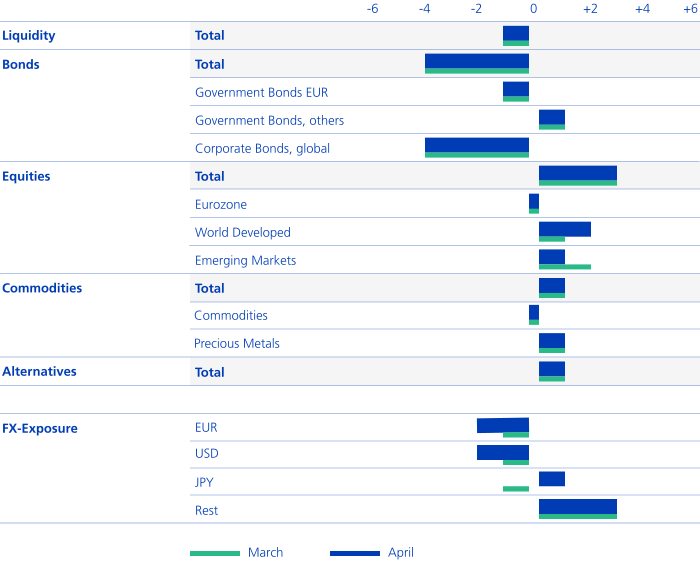
Asset Allocation Update EUR in April 2026


Relative weighting vs. Strategic Asset Allocation (SAA) in % in March and April 2026 (Source: Zürcher Kantonalbank, Asset Management)

Mentions légales

“BLOOMBERG®” and the Bloomberg indices listed herein (the “Indices”) are service marks of Bloomberg Finance L.P. and its affiliates, including Bloomberg Index Services Limited (“BISL”), the administrator of the Indices (collectively, “Bloomberg”) and have been licensed for use for certain purposes by the distributor hereof (the “Licensee”). Bloomberg is not affiliated with Licensee, and Bloomberg does not approve, endorse, review, or recommend the financial products named herein (the “Products”). Bloomberg does not guarantee the timeliness, accuracy, or completeness of any data or information relating to the Products.

This document is for information and advertising purposes only. It is intended for distribution in Switzerland and is not intended for investors in other countries.

It does not constitute an offer or a recommendation to purchase, hold or sell financial instruments or to obtain products or services, nor does it form the basis for a contract or an obligation of any kind. The recipient is advised to review the information, possibly with the assistance of an advisor, to determine its compatibility with their personal circumstances as well as its legal, regulatory, tax, and other implications. The information contained in this publication may be adjusted at any time.

The document was prepared by Zürcher Kantonalbank with customary due diligence and may contain information from carefully selected third-party sources. However, Zürcher Kantonalbank provides no warranty as to the correctness and completeness of the information contained therein and accepts no liability for damages resulting from the use of the document or information contained therein.

Unless otherwise stated, the information refers to Zürcher Kantonalbank's asset management under the Swisscanto brand, which primarily includes collective capital investments under Swiss, Luxembourg and Irish law (hereinafter referred to as "Swisscanto funds").

The investment opinions and assessments of securities and/or issuers contained in this document have not been prepared in accordance with the rules on the independence of financial analysts and therefore constitute marketing communications (and not independent financial analysis). In particular, the employees responsible for such opinions and assessments are not necessarily subject to restrictions on trading in the relevant securities and may in principle conduct their own transactions or transactions for Zürcher Kantonalbank in these securities.

The sole binding basis for purchasing Swisscanto funds is the current fund documents (e.g. fund agreements/contractual conditions, prospectuses, key investor information or basic information sheets as well as annual reports), which can be obtained from products.swisscanto.com/, Swisscanto Fund Management Company Ltd., Bahnhofstrasse 9, CH-8001 Zurich (also representative of the Luxembourg Swisscanto funds) or from all branch offices of Zürcher Kantonalbank. The paying agent for the Luxembourg Swisscanto funds in Switzerland is Zürcher Kantonalbank, Bahnhofstrasse 9, CH-8001 Zurich.

It should be noted that any information about historical performance does not indicate current or future performance, and any performance data provided may not consider the commissions and costs incurred when issuing and redeeming fund units. Any estimates regarding future returns and risks contained in the document are for informational purposes only. Zürcher Kantonalbank does not provide any guarantee for this.

Every investment involves risks, especially with regard to fluctuations in value and return.

The products and services described in this publication are not available to US persons in accordance with the applicable regulations. This publication and the information contained in it must not be distributed and/or redistributed to, used or relied upon by, any person (whether individual or entity) who may be a US person under Regulation S of the US Securities Act of 1933. US persons include any US resident; any corporation, company, partnership or other entity organized under any law of the United States; and other categories set out in Regulation S. Status of the data (unless otherwise stated): 03.2026

© 2026 Zürcher Kantonalbank. All rights reserved.

Categories

Investment Strategy